This article contains the content from the 10/21/2020 Bioneers Pulse newsletter. Sign up here to get the newsletter straight to your inbox!
“The problem is that Western thinkers tend to consider intelligence as a human exclusivity.” —Jeremy Narby, anthropologist
“We’re just one member of the democracy of species; the Earth does not just belong to us.” —Robin Kimmerer, Potawatomi Indigenous ecologist
Humans are a part of nature, not apart from it. Our innate capacity for intelligence suggests the same is true for the rest of our interconnected web of life. As researchers study the natural world, we find our notions of consciousness expanding.
This week, meet thought leaders whose work is transforming our curiosity about intelligence in nature into a full-fledged field of research — with deep implications for the future of our relationship with the natural world.
New Podcast Episode: Forest Wisdom, Mother Trees and the Science of Community
Forests have long occupied a fertile landscape in the human imagination, yet we’ve largely treated forests as inert physical resources to satisfy human needs and desires. The main operative science behind this commodification has been market science — how to extract maximum resources and profits.
This Bioneers podcast episode features Suzanne Simard, a revolutionary researcher who is transforming the science of forest ecology and coming full circle to the wisdom held by First Peoples and traditional land-based cultures from time immemorial. The story Simard is uncovering can change our story for how we live on Earth and with each other – for the long haul.
Intelligence in Nature at the 2020 Bioneers Conference
Paul Stamets and Mark Plotkin are two visionary leaders whose work has expanded our understanding of intelligence in nature. They’re also keynote speakers at the Bioneers 2020 Conference!
A Conversation with Merlin Sheldrake, Author of Entangled Life
Merlin Sheldrake is a biologist and a writer whose research ranges from fungal biology, to the history of Amazonian ethnobotany, to the relationship between sound and form in resonant systems. A keen brewer and fermenter, he is fascinated by the relationships that arise between humans and more-than-human organisms.
In this video interview, Bioneers Senior Producer J.P. Harpignies chats with Merlin about his new, highly acclaimed first book, Entangled Life.
Watch the interview here, and read an excerpt from the book here.
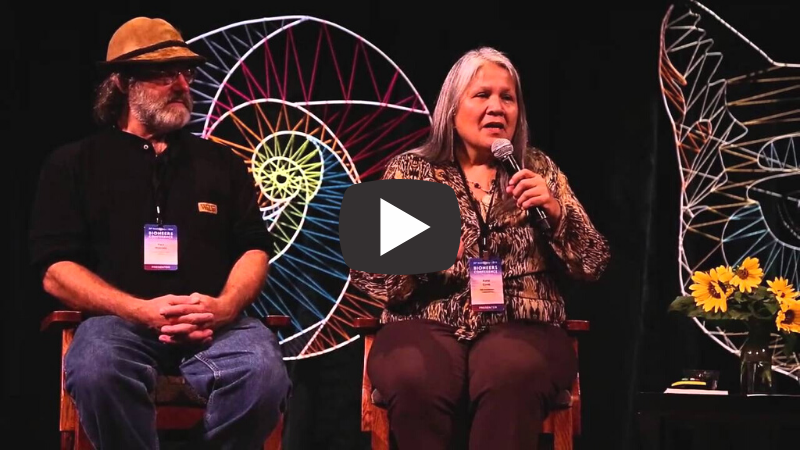
Paul Stamets, Katsi Cook and Jeffrey Bronfman – Plant Sacraments and the Mind of Nature
Can plants help people access the intelligence in nature—the “mind of nature”—that we must learn to understand in order to supersede our ecologically destructive habits? This panel discussion features Jeffrey Bronfman, founding member of the União do Vegetal church of the United States; Paul Stamets, master mycologist; and Katsi Cook, renowned Mohawk midwife and environmental activist. Hosted by J.P. Harpignies, Bioneers Associate Producer.
Stamets and Cook will also be speaking at the Bioneers 2020 Conference on December 5. Register now to join them for a voyage into the mind of nature!
The Honorable Harvest with Robin Kimmerer
What does ethical reciprocity between humans and the natural world look like? The Honorable Harvest reminds us how to take, use and share while mindfully honoring the indigenous legacies that teach us how to commune with our planet. Featuring Robin Wall Kimmerer, Professor of Environmental and Forest Biology at the State University of New York College of Environmental Science and Forestry.
She is the Ocean is a new documentary profiling nine extraordinary women from across the world who share one thing in common: a profound love for the sea. A love so profound that they have chosen to make the ocean the center of their physical, philosophical, and professional lives. Don’t miss this new movie, which premiered online and at select theatres nationwide earlier this week!
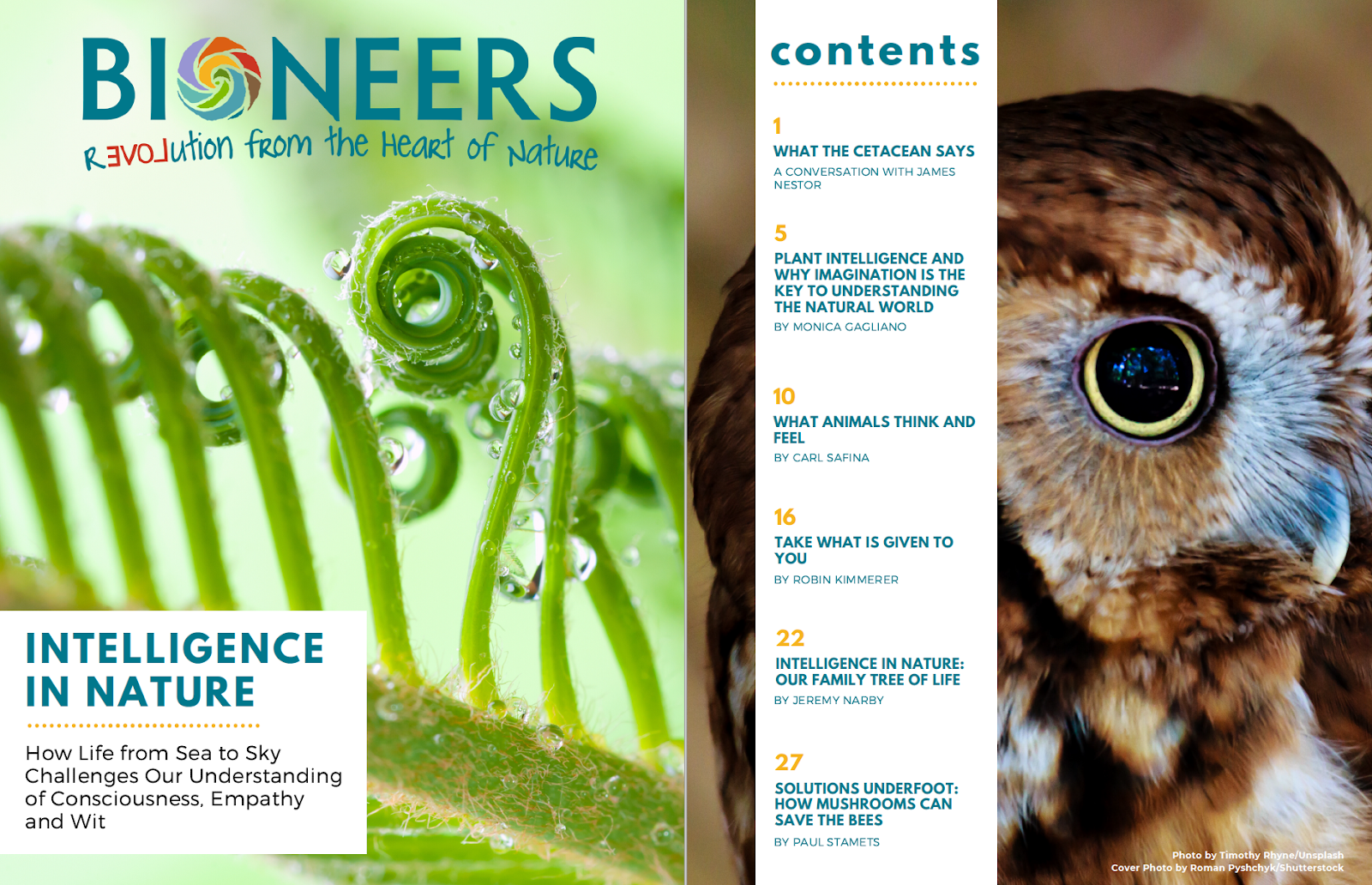
This Bioneers Reader features some of the world’s foremost thought leaders sharing their research and observations about nature’s intelligence. We’re excited to share a selection of the groundbreaking concepts buzzed about within our community, in a beautifully-designed package that’s free to download. Don’t forget to share this reader with your friends and family!
Indigenous Land Acknowledgement Bill Introduced in California | Check out this conversation between Indigenous rights activists Alexis Bunten and Dr. Joely Proudfit, where they discuss the meaning behind an Indigenous land acknowledgment bill being considered in the state legislature.
The Benefits of Biodiversity on the Farm and Ranch| Regenerative agriculture strives to mimic nature’s by building biodiversity as the foundation for a healthy ecosystem that results in higher productivity. In this article, Arty Mangan, Restorative Food Systems Director at Bioneers, tells the stories of regenerative farmers and ranchers using this system to their benefit.
A Geography of Hope: Gabriel García Márquez and the River that Made Possible a Nation | Wade Davis, PhD, is a writer, botanist, and Explorer-in-Residence at the National Geographic Society. In this excerpt of his new book, “Magdalena: The River of Dreams,” he weaves together a fierce defense of Indigenous wisdom, a searing indictment of climate change, and a memoir of an author’s travels.
This article contains the content from the 10/21/2020 Bioneers Pulse newsletter. Sign up here to get the newsletter straight to your inbox!
In this letter, Bioneers co-founder Nina Simons reflects on the process of adapting to the pandemic, co-creating the Bioneers 2020Conference, and discovering the “learning, sense of community and cross-pollinating of ideas are possible online.”
These past six months have shaken me to my bones. I’ve looked deeply into my own patterns and considered what has greatest value to me. I’ve dreamt of how I can be most useful — in service to beloved community, Indigenous Peoples, healing alongside the natural world and the liberation of women and girls— the many causes to which I’m devoted.
I’ve learned to practice staying centered while being rocked by battering waves of uncertainty. This time is stretching my heart’s envelope. It’s a test of resilience to contain this wide spectrum of emotion, from immense gratitude and tenderness to outrage and loss.
My gratitude for Bioneers surviving to meet this time runs deep, as does my appreciation for Kenny’s and our team’s leadership. Thank you to everyone who’s contributed in so many ways.
Now, many have felt their illusions of democracy and equity in this nation’s institutions have been dashed. But the opportunity to reinvent how we live on Earth and relate to all of Life looms large. It’s a collective visioning that has lifted my heart. Nature shows us that diversity is essential to a system’s resilience after trauma, and the spectrum of topics, people and ideas we gather will strengthen our social systems’ resilience to revision our pathways towards regeneration, even after all this destruction.
I’ve been amazed to discover how much learning, sense of community and cross-pollinating of ideas are possible online. And I’ve never known a time when peoples’ minds were more open to new ideas, nor our hearts hungrier for innovative and practical visions we can collaboratively work toward, as we each contribute our own piece.
So when we realized we could co-create a Bioneers gathering for December, we went for it. With your participation, we hope to coalesce a multiverse of grounded possibility and abundant solutions to illuminate where we may be heading, and how we can get there.
Each time my heart’s boundaries must stretch again, to be able to contain the depth of emotional response I’m feeling, I am thankful that it is flexing to bridge the worlds — not breaking. While my heart is breaking over and over again, that’s just how the light gets in.
Join Nina Simons at the Bioneers 2020 Conference on December 5-6 and 12-13. Get your tickets now!
Forests have long occupied a fertile landscape in the human imagination. Places of mystery and magic – of wildness and wisdom – of vision and dreaming. Yet beyond mythic realms of imagination, we’ve largely treated forests as inert physical resources to satisfy human needs and desires. The main operative science behind this commodification has been market science – how to extract maximum resources and profits.
Suzanne Simard is a revolutionary researcher who is transforming the science of forest ecology and coming full circle to the wisdom held by First Peoples and traditional land-based cultures from time immemorial. The story Simard is uncovering can change our story for how we live on Earth and with each other – for the long haul.
Featuring
Suzanne Simard, Professor of Forestry at the University of British Columbia, is an expert in the synergies and complexities of forests and the development of sustainable forest stewardship practices. Her groundbreaking research centers on the relationships between plants, microbes, soils, carbon, nutrients and water that underlie the adaptability of ecosystems, especially the below-ground fungal networks that connect trees and facilitate interplant communication. Learn more about Suzanne Simard and her work at her website.
Credits
Executive Producer: Kenny Ausubel
Written by: Kenny Ausubel
Senior Producer and Station Relations: Stephanie Welch
Co-Writer and Producer: Teo Grossman
Host and Consulting Producer: Neil Harvey
Program Engineer and Music Supervisor: Emily Harris
Explore More
Dispatches From the Mother Trees, Suzanne Simard’s keynote address to the 2021 Bioneers Conference, in which she discusses the dire global consequences of logging old-growth rainforests, and nature-based solutions that combine Western science and Indigenous knowledge for preserving and caring for these invaluable forest ecosystems for future generations.
Lessons from the Underground, a panel discussion from the 2021 Bioneers Conference featuring Suzanne Simard as well as Anne Biklé and David R. Montgomery, a wife and husband team of scientific researchers whose groundbreaking work on the microbial life of soil has revealed its crucial importance to human wellbeing and survival. Moderated by Bioneers’ Restorative Food Systems Director Arty Mangan.
Intelligence in Nature, a deep-dive resource featuring leading experts in this burgeoning field.
This is an episode of the Bioneers: Revolution from the Heart of Nature series. Visit the radio and podcast homepage to find out how to hear the program on your local station and how to subscribe to the podcast.
Subscribe to the Bioneers: Revolution from The Heart of Nature podcast
Transcript
NEIL HARVEY, HOST: One of the revolutionary researchers transforming the science of forest ecology is Suzanne Simard. She weaves a kind of ecological parable. It’s a story of community – of kinship – of diversity – of coevolution, cooperation and resilience. Call it the Tree of Life, as so many cultures have.
The story Suzanne Simard is uncovering can change our story for how we live on Earth and with each other – for the long haul.
This is “Forest Wisdom, Mother Trees and the Science of Community”. I’m Neil Harvey. I’ll be your host. Welcome to The Bioneers: Revolution from the Heart of Nature.
Forests have long occupied a fertile landscape in the human imagination. Places of mystery and magic – of wildness and wisdom – of vision and dreaming – sacred groves at the edge of civilization where enchanted beings dwell, where people become transformed in the ineffable face of danger, darkness and wonder.
Yet beyond these mythic realms of imagination, we’ve largely treated forests as inert physical resources to satisfy human needs and desires. Dating back to ancient Rome and Greece, this extractive mentality has toppled civilizations, turning forests into board feet, clearcutting what’s in truth a keystone in nature’s self-sustaining web of life.
The main operative science behind this commodification has been market science – how to extract maximum resources and profits.
Today the new emerging science of forest ecology is telling a very different story. It’s a story that’s both modern and ancient. Brilliant scientists are coming full circle to the wisdom held by First Peoples and traditional land-based cultures from time immemorial.
The daughter of a logging family who grew up in the towering forests of British Columbia, Suzanne Simard became a Professor of Forestry at the University of British Columbia where she studies forest science and the development of sustainable forest stewardship practices.
SUZANNE SIMARD: There are so many different kinds of forests in the world, so healthy is really place-dependent. The composition of forests it’s largely determined by climate. So a tropical forest looks way different than a temperate forest, which is in the middle latitudes, which looks way different than a boreal forest, which is in the high latitudes.
So diversity comes in many different ways, and really like this underlying principle that’s been proven in many studies, not just in forests, but in grasslands and in herbaceous communities in agriculture systems as well, that diversity increases productivity, it’s also related to health of the forest.
HOST: Simard’s groundbreaking research centers on the complex interdependent relationships in forests among the trees, plants, fungi, microbes, soils, carbon, nutrients and water.
It’s hard to overstate the importance of forest ecosystems to the health of the web of life. Forests are rightly called the lungs of the planet, absorbing a third of global carbon dioxide emissions. Forested watersheds provide 75% of accessible global fresh water. And forests are home to nearly 80% of the world’s terrestrial biodiversity.
Although we know how profoundly forests matter, modern society knows surprisingly little about how they actually function as a system. What are we learning today?
We spoke with Suzanne Simard at a Bioneers Conference.
SS: So what is a diverse forest? In the boreal forests, which are the northern latitude forests, there’s not that many tree species. But if you look at vertical structure in this forest, those forests are extremely diverse. If you think of trees and how they vary in height, and their crowns are in different places, well then other animals and plants will live in those different niche spaces in that crown that’s very diverse.
And then also belowground in those boreal forests, that are not very species rich in trees, are immensely species rich in fungi. And I think that one of the reasons that they’re very diverse there is because those fungi and the bacteria are acting on a very difficult environment to extract or to get resources like nitrogen and phosphorus that they can deliver to the plants. So they all have their own special little niche space that they occupy there.
In a tropical forest, it’s a totally different thing, where you could have hundreds of species in a hectare, of trees, whereas belowground there’s only a couple hundred of mycorrhizal fungal species it depends on where you’re looking, or which forest you’re in.
Even so, there’s the basic principle that a fully accessed community with lots of niche space is a productive community. That’s how the biodiversity works.
HOST: A community anchored in diversity is among the first principles in this ecological parable. But because industrial capitalism has treated forests first and foremost as profit centers, it has led to so-called “managing” them more like a factory than an ecosystem, exactly contrary to the very underpinnings of healthy forests.
Suzanne Simard experienced this lethal disconnect first hand while herself working as a forester. Along the way, she fell through the rabbit hole into the below-ground world of forests. She found, as the Hermetic Axiom suggests, “As above, so below.”
SS: I became interested in the below-ground world when I was actually practicing forestry, and the things that we were doing and people were doing in the industry — which was clear cutting, planting trees, weeding out things – plants – that they didn’t want, trees they didn’t want, trees like birch and aspen and cedar, making way for just one or two species — I thought it was wrong because it wasn’t the way I had observed how forests function and are patterned in nature, and I thought we should be emulating nature more closely.
And when I was studying these forest practices, I was observing that there’s a lot of disease in those forests. They’re really stressed out. The trees growing by themselves in these rows are not happy. They die. There’s a lot of death. So I wanted to understand why that was and how we could change that.
And of course I was always interested in how the forest works, but I knew that a lot of this disease came in through the soil, and so I thought, well, that’s the first place to look. And I was interested in how fungi interact with trees.
And so I started looking at these forests where they had cut out the unwanted species and cleaned them, kind of like biodiversity cleansing in forests, and to see what happened to the mycorrhizas. And the diversity of the mycorrhizal fungi went way down, just like it went way down with the trees. And that’s because different plants host different species of fungi, and so there’s a lot of co-evolution that goes on between these creatures, these symbionts. And so when you get rid of one of the symbionts, the other one goes too.
So that meant, too, that the potential for these trees to be connected by these fungi below ground also went down. So I figured out through many studies – that trees of different species were connected, and when the connections were severed or they were not nurtured – so not nurturing them means growing single species and weeding out all the other native plants – when they’re not nurtured, those symbionts die or they’re very low diversity.
And then I realized through many more experiments that when you sever those links that the communication between the trees actually is severed as well. I was able to show that when trees can’t interact like that, can’t have relationships through their connections, that they’re more at risk of disease. And so when that microbiome was not there, then the pathogens could really act or really take over these other trees when they were by themselves.
HOST: Just as nature banks on diversity and builds from the bottom up, it rewards cooperation. As microbiologist Lynn Margulis put it, Earth is a “symbiotic planet”– revealing another piece of the ecological parable puzzle.
Simard’s research has further found that – although the forest is a raucous symphony of life – it also has amazing soloists. Among these soloists are “Mother Trees.” It turns out they’re crucial to the vast below-ground cooperative networks that connect, protect and nourish all trees – connections well known to ancient aboriginal cultures. There’s good reason to call them “Mother Trees.”
SS: Most people don’t know this, but when you’re walking in the forest, you see these big, tall trees, and you think, Oh, that’s the tree. But actually there’s as much going on below ground as above ground.
A tree grows tall, but it’s got a root system but they also grow outwards. And a mature tree in our temperate forest will have root systems that go out like 30 meters. That’s like 100 feet. The root systems are as wide as the tree is tall. So that means that in trees, in a fully occupied forest, are only like a few meters apart, so that means that their root systems are completely overlapping.
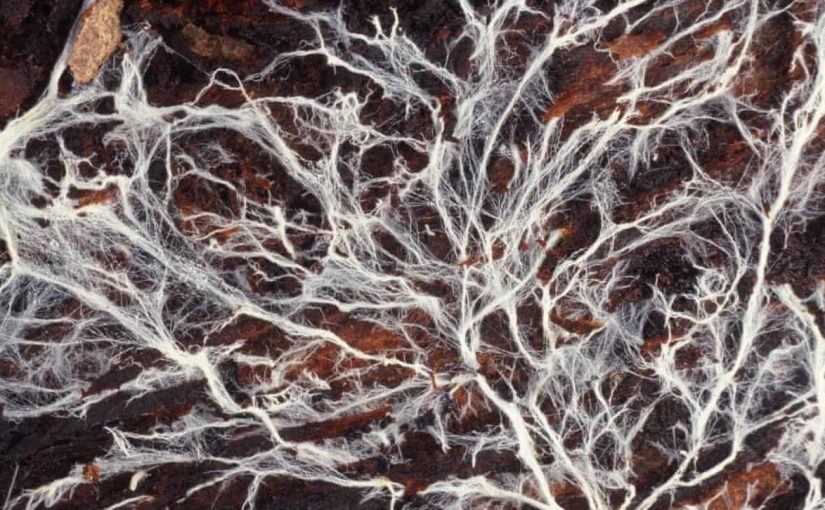
On top of that, every root tip on those trees, those massive overlapping root systems, every root tip has got a mycorrhizal fungus that’s linked to all the other trees.
A big old tree will produce cones and set seed. The seed falls at whatever time of the year. It disperses its seed often in the spring. Those seeds fall to the forest floor, and there’s immediately, as soon as they fall to the forest floor, there’s a lot of communication going on between the seed and the bacteria and the fungi in the soil.
So then the seed germinates, and within a month or two, the root, the hypocotyl of that seed, becomes colonized by a mycorrhizal fungus. That fungus is actually part of the big old tree that produced the seed, so that big old tree has already got a network of fungi, and the seedling, with its little root system, hooks into the network of the old tree
The old tree immediately starts communicating with the seedlings through the network. And the way that the old tree does that is it sends carbon down its phloem, into its root system, into the mycorrhizal network, and then the little seedling takes it up, and when a seedling is really young, just like in our own kids, they can’t look after themselves completely. It takes a little while. They’ve got to build leaves and they’ve got to grow a little taller, and they’ve got to photosynthesize enough that it’s more than respiration so that they can produce their own food. But at first they can’t do that, especially if it’s shady.
So that mother tree sends carbon, and later we also found that the mother tree sends nitrogen, and it sends water, and it sends signals, and can recognize whether they’re kin or not kin. And so this communication goes on between the parent tree, the mother tree, and the offspring.
Teenagers will talk to each other as well. They can be linked together and communicate. It doesn’t have to be mother and kin.
We know that they recognize which seedlings are related to them and which ones are strangers. And we think that there’s certain kinds of kin recognition signaling molecules involved in this, but we don’t know what they are. We know that carbon is part of the story because we know that mother trees will send more carbon to kin than strangers. So it could be that carbon is part of this signaling molecule, but we don’t really know for sure. So there’s some work to be done there.
HOST: Science is just beginning to scratch the surface when it comes to learning about how plants communicate. What else are trees up to?
One finding was a vast public health hotline coursing through the forest.
SS: The other communication language that we’ve been looking at is stress signaling. So if one tree is stressed, it can send signals to neighbors that say, Hey, I’m stressed out and you need to watch out, and you need to increase your own defense.
The big old trees are the ones that have the biggest crowns and they photosynthesize the most, and so they’ve got the most surplus carbon, and so they send the carbon into the network. And usually they—the other trees that are smaller and have less carbon through photosynthesis are the sinks. So it’s like this source-sink thing going on between big old trees and the younger, smaller trees. And that’s, we think, is how the carbon is moving through the network is it’s following a source-sink gradient from really replete areas to depleted areas.
So it’s redistributing the resources so that the community as a whole is vibrant and healthy, even the ones that are maybe struggling in the shade, they’re getting help from the neighbors through the network.
And there’s studies that also show not just below ground but above ground that this kind of communication is going on between trees about stress and injury, and that they change the community health based on that signaling. It’s like a public immunization program.
HOST: As we begin to look, listen and learn, what science is unearthing about the depth and complexity of forest ecosystems is astonishing. For instance, how is it that rivers and oceans reach deep into the life cycles of the forest?
One of the primary elements necessary for plant health is nitrogen. In some regions near rivers up to 75% of the nitrogen in trees can be traced to fish.
SS: Through lots of studies in Washington and British Columbia, they’ve been able to determine that this nitrogen is transported into the forest by different animals – bears and wolves and eagles – and that this nitrogen ends up not just in the trees but in other plants and even in the insects that are associated with those plants. But nobody knows how it gets from the salmon that’s been eaten by the bear and maybe pooped out or just left to decay, how it gets from that point into the tree.
And so what we’re trying to do is figure out how the mycorrhizal network picks up the nitrogen.
And then most interesting how that mother tree then moves that nitrogen through the network into the forest and how deep into the forest does it go? And what is the ocean influence? How far does it go into the forest?
And we think that it goes a longways, and without the salmon, the forest suffers, without the forest, the salmon suffers because the forest provides cover for the streams, which makes it habitable for the salmon. It’s a really great example of how animals and salmon and trees, and even people because they harvest the fish, are all linked together.
And it’s not just in those forests, but even in the Douglas fir forests where I live and do my research, the animals are all part of dispersing the spores, and eating the spores, and the spores of the mycorrhizal fungi which colonize the seeds in those animals, also the squirrels will harvest the cones and eat the seeds in the same place that they defecate out the spores, and then the colonization of the seed happens right there. So the squirrel or the animal is an integral and critical part of the loop between the fungus and the tree.
I think the more we look, the more we’re going to see that these links are strong, and they’re there, and there are multiple pathways.
HOST: When Charles Darwin published On the Origin of Species in 1859, it revolutionized our understanding of evolution. His theory of natural selection became popularized as “survival of the fittest.”
But he did NOT mean an amoral struggle for existence where might makes right — where the ruthless pursuit of self-interest automatically cleaves to the greatest good.
What Darwin was actually saying was that the “fittest” were the best fitted to existing conditions at a given historical moment in a specific environmental context.
In other words, evolution is coevolution, navigating by the North Star of symbiosis. That’s exactly what Suzanne Simard’s ecological parable is showing.
SS: We’ve had this misconception that healthy forests are made of all fast-growing trees, and that the biggest and fastest-growing is the best thing, but no, it’s not true at all.
If everybody’s a strong competitor– if everyone’s an alpha tree, then they’re going to fight each other to death, through shading and so on. If you have a structured forest where you’ve got small ones, and big ones helping out the small ones, and mid-canopy trees, and different species, they’re occupying all the niches in that forest, that diverse forest, and so that’s actually a much healthier forest, is to have that kind of diversity.
HOST: Simard says that symphony of diversity is exactly why it’s so important to conserve these mother trees.
There’s a parallel in marine ecology and fisheries management, where it’s increasingly common for regulators to protect what they call BOFFFs – Big, Old, Fat, Fecund, Females. Pound-for-pound, in some species BOFFFs can produce vastly more life than any other fish in the population. Protect Big Old Fat Fecund Females, and the population will thrive.
Simard’s work has shown that the same holds true for trees. As forests are jamming into fast forward to try to adapt to radically accelerating climate change, protecting mother trees will be an essential practice for supporting climate-resilient forests.
The implications ofSuzanne Simard’s research extend beyond large-scale forests. She says our expanding understanding of plant communication can also offer promising practical applications, especially in this time of severe climate stress. One example is in agriculture, helping plants share much needed water in times of drought.
SS: So like a winery, for example, the roots will be accessing a very narrow niche space in the soil, and that makes it very vulnerable so that when there’s a drought, they can’t access water that might be in different places in the soil profile.
So what can you do? You can actually start mixing plants, and if you know about the species of the plants and how they communicate with each other and how they interact with each other, you can actually start creating polycultures of plants so that you have some that are deep-rooted ones, you have some that are sort of middle-rooted ones, some that are—maybe the vineyards are shallow rooted. And what happens under a drought situation is that those plants, the deep-rooted ones, like the trees, will access water in the deep aquifers, bring it up, and share it with the vineyards, for example, through mycorrhizal networks. And then you keep the whole system watered. The water cycles through the system and it keeps it living, and a living canopy will trap more water, there’s more transpiration going on, there’s–you know, they’re accessing other parts of the soil profile that are bringing up nutrients as well, and then if you do that, you have a resilient system. But that’s all based on our understanding of how these plants are able to communicate with each other and access different pools of resources in soils that results in a really healthy and resilient plant community.
HOST: If there’s one fundamental systems error in the modern mind, it’s the delusion that as human beings, we’re apart from nature. In truth, we’re a part of nature. We are one small late-blooming branch on the 3.8 billion-year-old Tree of Life.
As a forest ecologist, Suzanne Simard says the ecological parable of forests has direct and timely relevance to how we can organize our human societies.
SS: It’s a very potent mix of looking at these patterns and processes in nature, and how can we use that to help us understand these other systems, because these systems, basically from what we’ve discovered, is that they’re patterned very similarly. So we can learn a lot from that, like just say, in society about cooperation. Well you know, cooperative societies where specialists in different areas, even though they’re diverse and have different roles, if they can cooperate on different levels, then you have a more robust community that’s more productive and healthy, and the people within it are healthier.
And then of course combining society with a good functioning healthy ecology also is of course a potent mixture for happiness and health.
HOST: Suzanne Simard believes that the story of interdependence and mutual aid emerging from the science of forest ecology is already deeply wired in our collective psyche. It’s embedded in spiritual and religious traditions, and in family and social codes.
The leap today is to expand those ethics of right relationship to the natural world.
Although scientists scrupulously avoid ascribing human qualities to the natural world, Suzanne Simard uses the term “forest wisdom.” For a scientist who rigorously documents the astonishing sophistication and complexity of this forest symphony, is it in fact valid to apply words such as “intelligence” and, yes, “wisdom?”
SS: I started using that word when I realized that—or my science was showing me that we can deconstruct a forest and look at the mechanisms, like of communication and networks, but there’s so much of it that is beyond explanation. We’re not ever going to fully know, because there’s a lot of emergent things that come out of that that you just can’t trace.
And to me that’s intelligence, and wisdom – that it’s more than just a bunch of parts that are working together. It’s more than just a bunch of networks. It’s more than just a bunch of leaves. It’s that they’re all working together to create something that’s much, much more than that.
But there’s also that mother trees can recognize her kin and intentionally transfer carbon to her kin seedlings to favor them.That’s a behavior that has got intention and consequences, and there’s decision-making going on there. Right? There’s a choice.And we could deconstruct that to physics or something like that, but when we were starting to discover that she recognized her kin and could send more resources, I thoughtthat’s wisdom, because there’s intention there. There’s a sentience.
There’s a lot of resistance among, you know, more traditional scientists of using those kinds of words to describe plant behavior and how they perform and function, but that’s just because we’ve invented those words for ourselves and now we’re applying them. But they’re apt descriptions when you look it up in the Oxford Dictionary. It is intelligence. It is wisdom.
HOST: Call it the Tree of Life. Call it Forest Wisdom…
We’re not alone. There are an estimated 10-14 million species living on earth today. The complexity of life is so great that an estimated 86% of those species have not even been documented.
The numbers are impressive, but the way species interact – at times as competitors, but more so as symbiotic communities – may even be more remarkable. The web of life is held together by relationship. One species’ waste is a resource for another. Different species often work in cooperative enterprise for mutual benefit. For example, in a healthy soil system microbes that have been fed by the carbohydrates that a plant produces and exudes through its roots, in turn supply the plant with essential minerals and, in some cases, can even mediate nutrients between two nearby plants if one has an excess of a certain mineral and another plant has a deficiency.
Life on Earth is built on biodiversity and driven by the interaction of species and the collateral ecosystem services those relationships produce. Regenerative agriculture strives to mimic nature’s organizing principles and apply them to farming systems by building biodiversity as the foundation for a healthy ecosystem that results in higher productivity.
Doniga Markegard with her daughters
Doniga Markegard, an author, rancher and mother, observes nature closely to inform her ranching practices. “We ranch on California coastal prairie grasslands that some people might consider marginal lands. They’re not lands that people would grow carrots or strawberries on. There’s no irrigation. It’s not flat. It’s very hilly, rolling, natural landscapes. Those grasslands evolved with large herds of ruminants. In our case, in the most recent history, it was elk and American pronghorns that grazed those lands in large numbers. The early accounts of the settlers were that there were elk herds maybe 2,000-head strong.
“Grazers have a symbiotic relationship with grasslands and the other species within those grasslands. It takes a whole intact ecosystem to create a real balance. That’s what we’re looking towards. We want abundance; we want all species to flourish in a balanced way. We don’t want one species taking over the grasslands completely; we want diversity.
“Nature abhors a monoculture and thrives with biodiversity. Biodiversity provides checks and balances. A very important part of that system is the role of predators. The wild ruminants leave just enough nutrients in the form of dung and urine to fertilize the grasses, but before they overgraze and damage the grasses, the predators force them to move to a new area. In that way, all three species are taken care of.
“Since the predators and the large herds of grazing animals no longer exist in that dance with the grasslands, we try to mimic that relationship. We bring in cattle as the ruminants, and we bring in electric fencing, which functions like the predators once did to keep the cattle bunched up, and then, as we move the fencing, the cattle move on to fresh pasture. The pasture where the cattle recently grazed then flourishes from everything that the cattle left behind – the manure, urine, saliva and the disturbance. We’re really ranching like a prairie would ranch, as if the grasses really matter, as if the wildflowers matter, as if the voles matter, and as if the soil matters.
“California grasslands have some of the highest plant species biodiversity of all grasslands in North America. People don’t view California as a prairie state, however, our prairies are incredible. On one ranch alone, we have 157 species of plants, and we never planted a seed. This is the result of our stewardship and management approach of working with nature to provide abundance and build biodiversity.”
Elizabeth and Paul Kaiser met in Gambia, Africa while in the Peace Corps. Paul worked on Agroforestry projects and Elizabeth was involved in improving public health. In 2007 they started Singing Frogs Farm in Sebastopol, CA.
Elizabeth Kaiser, Singing Frogs Farm
In an interview I conducted with them, Elizabeth described the biodiversity on their 8-acre farm: “One of the first things we did was plant perennials. If you walk through our fields you won’t go more than 150 feet without passing by a large grouping of perennials, usually in the form of a hedgerow. That’s also true all around the perimeter of the farm. We used our own funds for about a third of those plants. We also got USDA funding through our local regional conservation district to put in 3,000 Sonoma County native pollinator-friendly plants over nine years. As those have developed, there’s just been an amazing transformation of the life on this farm.”
Paul added, “All of those plants have an indirect economic benefit in that they also harbor beneficial insects. Plenty of research has shown that perennial plants tend to harbor beneficial insects whereas annual plants tend to harbor pest insects. By creating huge hedgerows of perennial bushes, every 100, 150 feet throughout all the fields and all around the perimeters of the farm, we’ve created substantial habitat that has dramatically increased the overall quantity and diversity of beneficial insects and pollinators on the farm.”
Paul and Elizabeth are wonderfully complementary and often finish or expand on each other’s thoughts. “Most of our crops are annuals,” Elizabeth said, “but the perennials are just as important. They’re pulling up different nutrients, they’re shedding their leaves, they’re providing habitat for pollinators and beneficial insects and beneficial animalssuch as snakes and songbirds that are eating pest insects.”
The Kaisers maximize their small scale by farming intensively, planting 3-8 sequential crops per year on each bed and in some cases two different crops inter-planted in the same bed. Their modus operandi is to grow as many different plants as possible. Growing a diversity of food crops enables them to offer a wide variety to their customers through their CSA and local farmers markets. That diversity is also a benefit to the soil, as a variety of plants feed the soil microbes a wider spectrum of nutrients when they break down and decompose. As a result of that and other regenerative farming practices, Singing Frogs Farm has increased soil organic matter, an indicator of soil carbon and soil health, by 400% in just six years.
Regenerative farmers and ranchers are working to change the conventional agricultural mindset that nature is the enemy that must be attacked and eliminated with pesticides, herbicides and habitat destruction. Instead, ranchers and farmers like Doniga Markegard and the Kaisers are figuring out ways to live in harmony with wildlife and still have a productive operation.
Doniga offered me an example: “Our ranches are part of a rangeland monitoring coalition with Point Blue Conservation Science, which carries out a number of studies on threatened and endangered species. On our ranch, we have a high population of red-legged frogs in our stock ponds that my husband built. They wouldn’t be there without the rancher and the cattle. We have some rare and endangered plant species because those plants evolved with grazing animals. Without those grazing animals, the biodiversity plummets.”
Biodiversity is a cornerstone element of regenerative agriculture. Regenerative ranchers and farmers are bringing vibrant, diverse life back to working landscapes by designing their systems in ways that reflect the dynamism and life-promoting forces of nature. The notion that ecosystem degradation is inevitable on lands that produce food is being challenged. Singing Frogs Farm and the Markegard Grass-Fed operations are elegant examples that demonstrate that successful farming businesses can also be good stewards of the land by supporting a wide diversity of life.
Lyla June is a poet, musician, anthropologist, educator, public speaker and community organizer of Diné, Cheyenne and European lineages who has addressed audiences across the globe with a message of personal, collective and ecological healing. She blends studies in Human Ecology at Stanford, graduate work in Indigenous Pedagogy, and the traditional worldview she grew up with to inform her perspectives and solutions.
I had the incredible privilege of getting to hear Lyla June speak at Bioneers a few years back. I was deeply moved by her wisdom, her fierce grace, tenacity, and deep commitment to making the world a just and beautiful place. I have been following Lyla June’s career ever since, and all that she has done is an incredible inspiration. I was honored to get to interview her for Bioneers to talk about her perspective on this time that we are living in and how we can move forward in a good way. I hope you will enjoy it as much as I enjoyed speaking with her.—Polina Smith, Bioneers Arts Coordinator
POLINA SMITH: What’s your perspective, as an artist, an activist and a Diné woman on this historical moment we’re living in?
LYLA JUNE: Greetings my kin and my people. My name is Lyla June, and I come from the Naaneesht’-ézhi Tááchii’nii (The Charcoal Streaked Division of the Red Running Into the Water Clan) of the Diné Nation, widely but incorrectly known as the Navajo.
For me as an artist and all the things that Creator has made me to be in this lifetime, these times are really about learning. You know, there’s a very important principle within Diné cosmology about learning from one’s trials and tribulations. My elder, Philmer Bluehouse, talks about this a lot. We are here to learn, and we will learn through both positive things and negative things. We’re in a heavy learning space right now.
The American experiment and the capitalist experiment were never going to work in the long run. It seemed like it could work for a while—patriarchy, white supremacy, human supremacy over other species, male supremacy, all of those things; they were never going to last, so I feel like our bill is coming due. We’ve written all these checks and we thought it was going to work, but now it’s time for us face the consequences of our actions.
So from the global climate crisis to the breakdown of the American democracy (which for Native people has never been a democracy); to the huge fires that reveal that American society doesn’t know how to manage land, soil and water; we’re finally seeing the consequences of centuries of doing it wrong, but I don’t see it as a curse. I actually see this as a gift, a chance to learn how to get it right.
POLINA: That is a very positive way to look at it, but there’s so much heartbreak, so much trouble in this time. How do you navigate it, and how do you suggest we navigate it?
LYLA: Well, prayer is always one answer. We have a lot of stories about periods of collapse in our Indigenous cultural narratives, so there’s this background feeling that we’ve been through this sort of thing before. In Diné cosmology we’ve already experienced the destruction of four or five worlds, so as a culture we’re actually very accustomed to this idea of worlds dying and being reborn.
One of them was with a flood, which happens to be a recurring theme in cultural narratives throughout the world, so we don’t think these are just stories. We think this actually happened. Some of the collapses are social. Things come to a head, and people are forced to evolve or perish. One of those collapses took place in Chaco Canyon. Our people then had caste systems and slavery there and didn’t manage their land well. A lot of Diné people won’t go to Chaco Canyon for that reason. A lot of tourists go to see the archaeological site, but we as Diné never go back because that’s a place where we messed up.
At that time the youth rose up and the Creator sent us a drought, which we needed to give us the courage to change, and then we broke apart and eventually started new, much more evolved societies. We had to learn by going through the fire. Similarly, there’s a California tribe who say that they were in a state of famine, and everything was hard, and the women cried and prayed for their dying children. That prayer, that love, is what gave rise to the acorn maidens coming down to teach them how to gather, prepare and eat the acorns. There are a lot of different stories of collapse and rebirth like that around the world. Europeans have had that too. They had quite evolved social systems that were destroyed by conquerors on many occasions. The conquest of tribal peoples by the Romans, and then the collapse of the Roman Empire centuries later is a famous example.
So, I guess the way we manage it, the way I’ve heard of people managing it (and I’m not an expert) is through prayer, always asking for help. As they say: “When you hit rock bottom, the only place to look is up to Creator.” And humanity right now is going through a collective hitting of rock bottom, so maybe we’re finally waking up to the fact we have a big problem, like an alcoholic who finally faces up to his addiction. Maybe humanity is ready to admit: ”OK. Maybe I don’t have everything figured out. Maybe my universities don’t hold all the knowledge we need. Maybe what’s taught there is on some level actually part of the problem.” And I say that as a Stanford graduate. So I think that’s how we manage it, through humility and prayer, asking for guidance.
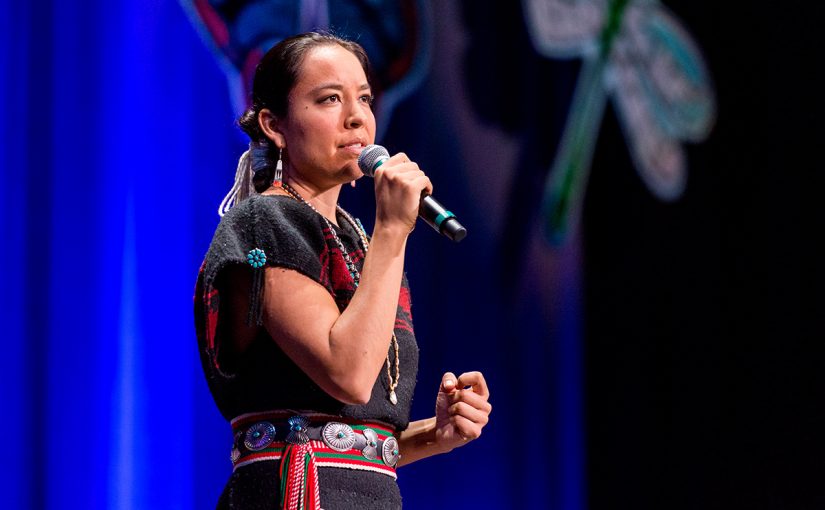
Lyla June speaks in a workshop at Bioneers 2018. Photo by TrimTab Media.
POLINA: As you were speaking, I was thinking of one of my mentors who often says that how we humans learn is by falling to our knees before being able to rise again. We need to be willing to embrace our failures and learn from them so that we can move forward, but many people in positions of power don’t seem to have that ethos, so how do we deal with people like that, when their desire for power is so, so strong and they lead us to destructive places?
LYLA: Creator did not design this world to have hierarchy. Hierarchy can rule for a time, but it will always perish, as it must. It cannot exist on land as sacred as this. For 500 years here on this continent we’ve had an oppressive hierarchical system, and we’re now finding out that it doesn’t work. One good thing about unsustainable behavior is that it can’t be sustained. Only love is sustainable. That’s how Creator made it.
So, yes, we are in this weird little point in time during which it looks like these crazy politicians are winning, but in the grand scheme of things, if we think on the scale of seven generations, it’s a short-lived thing, so we really don’t have to worry about empire. Empires take care of themselves. They may last a few generations, but they all die eventually. The sad part is that they do a lot of damage on the way up and down. I’m not trying to downplay that. It’s heartbreaking, but that model doesn’t win in the long run.
POLINA: But are there specific things that give you hope during this time?
LYLA: I would say the seeds, and our elders’ knowledge, and the intuition that we all have, and honestly the catastrophe itself gives me hope. I know that sounds strange, but when I was in Chile in 2010 they had an 8.8 earthquake, and I’ve never seen people come together with that much love for each other, ever. That’s what we’re going to end up doing. This catastrophe is going to bring us together. Sure, there will be some people who try to exploit it and capitalize on it, but I think it will bring out the best in a much higher percentage of people. It will bring out the beauty in us and force us to focus on what’s essential, not trivial stuff like who’s on the front page of this or that magazine.
These negative consequences are actually our friends, because they reveal the truth; they show that you pay a price when you abuse the land. You cannot have monocultures and genetically modified plants and animals. You cannot play God. You cannot douse your crops with pesticides and herbicides and destroy the rivers and the oceans. You can for a time, but the bill will come due. We can act like we’re the kings and queens of the whole world for a little while, but Mother Earth is starting to smack us down harder and harder to let us know we’re not. If we have the humility to be students of catastrophe, to learn the real lessons we are being offered, we are bound to become wiser and stronger people in the end. Every culture has had to go through that at some point. We’re just doing it on a global scale now, which is very hard, and the stakes are higher, but it’s a good thing if we draw the right lessons from the hardship.
POLINA: Lyla, you were involved with politics, running for office in New Mexico for a time. What was that like? What did you learn from that experience?
LYLA: I’m still processing that. Well, first of all, I managed to raise over $100,000 in 20 days through generate grassroots donations to compete with my opponent at the time who was (and still is) funded by oil and gas and big pharmaceutical companies, and casino interests. You could say he’s a representative of the addiction industries—oil, drugs, and casinos. But, to be honest, it was really hard, because I came with my whole heart and I was probably a bit naive. I thought: “I can do this! I’m going to be the next AOC, and it’s going to be great.”
But because I posed a threat to the really powerful fossil fuel industry in the Permian Oil Basin, which straddles New Mexico and Texas, there was a lot of money at stake for these people. A lot. And my opponent was and still is the speaker of the house in NM, so they stood to lose a lot of power if he lost. So they just did everything they could to crush me, and I just didn’t have the resources or the team to overcome that. That’s one thing I learned: If you’re going to run for office and be an actual threat to the powers that be, you need to have a very, very, very strong team of experienced people with you. And I just didn’t. I had wonderful people who tried to help me, but they were not equipped with the knowledge or skills or networks to help me out when the storm hit.
Long story short, they just slandered the heck out of me. They turned some of my own staff against me; paid people off. It got really ugly. But I learned a lot. I would know how to run a much better campaign next time, if I decided I wanted to do that again, but I’m not really thinking of that at the moment. I’m leaning more towards working outside of the colonial institutional box and sort of doing things that would make sense to my ancestors in this time and work in spaces that have fewer limitations. You can only make change as a politician to the extent that the colonial paradigm accepts it, but at the end of the day you are in that construct.
There is positive change that can be made in the political system, and it’s important and worth doing, but it will only give us so much. We also need to do a lot of other deep cultural work, so that’s why I’m working on trying to start an Indigenous university where we can actually study our own cultures on our own terms for our own purposes, and rekindle the teachings of our elders, and make a space where that knowledge is respected and effectively transmitted to the next generation. So right now, that just seems more productive to me, and, honestly, it’s an area I think I can be more effective in given my specific skill-set and my experience. But there’s no doubt that what happened on that political campaign stung. It was hard. I wouldn’t say I’m totally on the other side of it, but I’m much better. I’m getting there.
POLINA: Could you share a bit more about that vision of an Indigenous university and how the idea came to you?
LYLA: I’m still in a learning phase. I’m not an expert about Indigenous education, but did experience Stanford as an undergrad, studied American Indian Education at the University of New Mexico for my masters and I’m currently obtaining my PhD in Indigenous Studies from the University of Alaska Fairbanks. So I’ve been through the school system a lot. I’ve seen a lot of Native youth go into the school system, and in many ways it winds up being basically a modern-day form of assimilation. We have to give up who we are and how we see the world in order to get a degree. Our social status and our economic wellbeing is held hostage unless we get these degrees, which 99 percent of the time involve adopting world views that not only don’t respect our cultures but contribute to their destruction, as well as our lands and our people.
Most of the disciplines within the American university system are rooted in colonial ways of seeing the world, so I would love to have a place where Indigenous people could just learn and grow and obtain certificates and degrees in real skills that would actually help them and the world without forcing them to lose themselves and their souls, and their hearts, and their people, and their cultures. That’s something I’ve been dreaming of for a long time.
It’s looking more and more possible all the time because we are building the kind of networks that we will need to actually put it together. We’re in a research phase now, looking at what’s happening in some other nations, such as what the Maori and different peoples in Mexico and Canada and South America are doing, creating schools already. We’re in fact behind the times here in the States, compared to what a number of Indigenous peoples are doing in other places, so it’s time to do that, and hopefully, if we plant that seed today, who knows what it could become in a century or two centuries from now.
POLINA: Lyla, one thing that you speak about very powerfully is your own past of dealing with different addictions and coming out of that. Could you talk a little bit more about that journey, what you learned from it and what you can say to people who might be struggling in that way right now?
LYLA: Well, I still have addictions. They’re not chemicals now. They’re things like workaholism, so I’m still working on my healing journey. Basically it comes down to the basic kind of path you’re on: Am I choosing to face and learn from the pain of life, or am I avoiding those feelings through different forms of escape? At any given moment, we’re all doing one or the other, and it’s something I still have to struggle with. Feelings can get really uncomfortable for me because I fear that if I feel a little, then the whole dam will break. So I’ve been taking time to sit with that ocean of grief, so that I can then release it and learn from it. The political campaign was like that — a challenge, a catastrophe. I was lucky to have the guidance and support to become a student of that and use it to grow.
This is a good change, because most of my life I was trained to run from feelings. I grew up in an environment where there was a lot of drug dealing and addiction. That was very normalized in my little brain as a kid, so I started doing drugs when I was 11 years old, and that was my way of running, early on, from everything that was going on. Then I started to do pretty hard drugs and partying, which is part of what they dug out of the closet to smear me during the election.
POLINA: Oh my god.
LYLA: Yeah. I experienced child sexual abuse, and it kept going all throughout high school. I did not know what healthy intimacy was. I had no model of it, no compass. Mixing drugs and alcohol with sexual intimacy seemed normal in the worlds I had been exposed to. My path of healing isn’t just about overcoming addictions to substances; it’s about healing my understanding of myself, my body and the ways we should relate to each other in this world.
So I sometimes talk to people about these issues when I feel it can be helpful for me to share my experience and to explore how we can come to love ourselves again after experiencing these sorts of traumas. How do we come to see our own sacredness again? We have to start by having the courage to feel what really happened to us and to really understand deep in our bones that it wasn’t our fault and that we aren’t bad people. A lot of us women blame ourselves if we are raped. And my definition of rape is very broad. Anytime you do something intimate because you “have to” and not because you want to. There are all kinds of ways we can get pressured into doing things we really don’t want to do.
I finally got sober at age 23. I’m 31 now, so I’ve been clean almost eight years. I’m so grateful for it. I love every minute of it. I haven’t had a drop of alcohol or a puff of anything, or any pills, nothing. I made it to Stanford somehow and graduated with honors, even though I didn’t really get sober until my junior year.
All of these addictions are simply us abandoning ourselves, abandoning our inner child. I’m really into Margaret Paul right now, a wonderful author of a book called The Inner Bonding Workbook. She says that what we’re doing when we reach for an addiction is avoiding feeling an aching inside instead of exploring why we’re aching and being there for ourselves. You have to learn not to run away from the feeling but to sit with it.
POLINA: It’s extraordinary, Lyla that you were able to have gone through high school and then to Stanford with all that turmoil in your life. The tenacity of your spirit is extraordinary.
LYLA: Thank you, but you know, I’m still trying to figure out if that was tenacity or simply another form of escape. I had a very bizarre drive to be the best, and that’s not always healthy, so, to be honest, I don’t know if that was the healthiest expression of my being. Who knows what I would have done if I didn’t feel that drive when I was younger. I was a high-functioning addict.
POLINA: Was there a specific moment when you quit the chemical addictions?
LYLA: That big earthquake in Chile broke my hip and my spine. I couldn’t walk for two months. I was at rock bottom, and I prayed for divine help. I was finally ready to ask for some help and to admit that I had a problem, that I was an addict. And boom that changed everything. Creator was literally ready the whole time. He just needed me to ask for help!
The more nuanced answer, though, is that, as I mentioned before, in order to stop the drugs, I had to heal from the rape. So the way Creator answered my prayer was to send me some very special mentors in my life who helped me understand that just because they touched my body doesn’t mean they touched my spirit. You are unchanged. You are unscathed. You are your spirit, not your body. The body’s here today, gone tomorrow. The spirit remains. They said: “We don’t see you as a victim, we see you as a veteran of a war, not just against your body, but against your self-esteem, and we honor you the same way we’d honor a veteran coming home from war.” So it wasn’t a bad thing anymore; it was almost like a badge of honor. I survived and I still have love in my heart. That’s amazing. But it all started with that prayer and that realization that I was really ready to get sober. After that all of this help, all of these mentors, all of this spiritual support came to me to show me a path forward.
Lyla June’s keynote address at Bioneers 2018. Photo by Nikki Richter.
POLINA: I wonder what you think about how our personal addictions relate to our societal addictions to things such as fossil fuels and our wasteful way of living. Can dealing with personal addictions be a gateway to start thinking about quitting larger destructive societal addictions and dream a new world into being?
LYLA: Absolutely. I think that America is also running from feelings. It’s running from its past, from slavery and genocide and dubious wars. That feeling of guilt is so scary that they would rather write whole textbooks that completely omit the truth. They’re running from that feeling, so I think you’re absolutely right. The same principles that applied to me healing from my abuse apply to America healing from its past.
I abused people too, albeit unknowingly. If you grow up in an abusive environment, you are very likely to view that as “normal behavior” and think it is “okay” to abuse others in turn. European history is full of things like the Inquisition burning women at the stake and countless brutal wars. Europe was sort of a torture chamber on and off for about 2,000 years. It was horrible. Our ancestors on that side really went through intense suffering, so they tend to perpetuate abuse because it’s a hard pattern to break. To break the chain, you have to build the courage to look at how you’ve abused others. That’s not easy. You have to first just sit with it. It’s not going to kill you. It feels like it’s going to kill you, but just sit with it and explore it, investigate it, and come out the other side as someone who’s wiser and stronger.
POLINA: I’ve heard you talk about larger positive and negative spiritual forces that act through us and that act differently for women. Can you explain that more fully?
LYLA: I don’t mean to get too hetero-normative; there’s a lot of space for non-gender-conforming relatives in this discussion, but for the sake of simplicity at this moment, the way you destroy a woman’s spirit is different than the way you destroy a man’s spirit. As a woman generally speaking, one of our covenants with the Creator is that we have the capacity to bring forth life. That’s of course not at all the only way to express womanhood and it’s not everyone’s role or fate, but it’s one of our covenants: we are willing to bring life should Creator send it to us.
Conversely, the male covenant is to protect the sacred. So the way that negative spiritual forces can trick a woman are different than how they can mislead a man. If a woman accepts the trick and the lie that the rape is her fault, she can start to believe she has desecrated her covenant. She can start to feel awful about herself. It is a trick of coyote. Not the truth. And we’re really good at blaming ourselves. It’s my fault I drank alcohol or didn’t say no loudly enough, etc. If we believe that lie, it’s the first chip away at our spirits.
For the men, their spiritual goal is to protect the sacred. So if they accept the trick and the lie that the domestic violence is their fault, they can also start to hate themselves. For instance, if their mom gets beat up and they can’t stop it or protect her. Even if he is just a toddler the boys often blame themselves, which makes them think they’ve failed in their covenant of being a man. That’s when overcompensation and other forms of unhealthy behavior come up.
We have to bring these folks back so they can build the inner courage to face what has happened and to find the sacred within themselves. They have to realize that in many cases it wasn’t their fault. They were in situations in which Coyote, those negative forces, were just too strong when they were young and vulnerable, but then they have to be willing to face the truth that somebody did indeed hurt them, or those they love and work to change, to reconnect with Creator and feel that they are worthy. It’s not easy, but it’s always a prayer away.
POLINA: But when people rape or commit acts of domestic violence, can you really say it’s not their fault?
LYLA: I think we have distinguish those who hurt people as a result of their damaged childhoods and resulting lack of control and desperation and those who hurt people very knowingly, coldly, for their totally selfish advantage. Both need to be forgiven, but what are you forgiving? Are you forgiving someone who didn’t know any better? Or are you forgiving someone who did know better and still did it? Unconditional love is what I choose for both. But you have to forgive what really happened. Unconditional love doesn’t mean you ever have to see them again, as that wouldn’t be safe. But in your heart, you forgive and pray for them.
POLINA: These are really tough questions. Women and gay and transgendered people are victimized a lot, and we have seen so many people in power exposed through the #MeToo Movement, but our incarceration and criminal justice systems have also completely failed us. So what does justice look like? What could the vision of a real fair justice system be? And should we be expected to forgive or is it up to perpetrators to come forward and ask for forgiveness if they really find the truth within themselves first before we can forgive them?
LYLA: Yeah. Those are questions I’ve been grappling with my whole life, and I don’t proclaim to have the answer, but obviously forgiveness is a big part of my story. It had to be for me to heal at all. When I was healing, my elders said it was a three-step process: first look, then feel, and finally forgive. Looking is hard because what if you look, and it turns out you really are the person you feared you were; you really are a tainted woman or a “bad” man?
Generally I think that if you can have the courage to look anyways, what you find is that at your core, you’re quite wonderful, and something really bad happened to you. Then you can start to let yourself feel, and then forgiving is both the first and the final step of true healing, because you relieve yourself of the last wound they served you: the wound of the bitterness and hatred we carry.
But for those in positions of major power who have gravely not just broken human laws that are written on paper but cosmic laws that threaten countless people and living things, maybe there need to be much bigger consequences, but I’ve thought a lot about the carceral system. My brother’s in the carceral system, and we know how racist that system is and how black and brown people are jailed much more readily and treated so unfairly. So I don’t believe in that system as it exists, but there have to be consequences for harming others. In many Indigenous cultures if someone ever beat a woman, say, they were simply ostracized, and that was equivalent to a death penalty, because it was hard to survive alone. That’s not at all to say I condone the death penalty; I’m just giving you an example of how seriously this was taken.
But I don’t know. I really don’t know. What I do know is that I believe in love. I believe in forgiveness. I believe in prayer for those who have harmed, are harming. I even pray for Trump regularly, and most people I know think I’m crazy. I believe that prayers do have an impact, but I also believe that first and foremost getting ourselves to a safe space is the first priority, and some people have to be prevented from harming us, even if we can forgive them.
POLINA: Thank you so much, Lyla. Thank you so, so much for your time and your words and your wisdom and your work and your art. Before we end, is there anything that we didn’t talk about that you would like to say?
LYLA: I think the only last thing I would say is that I encourage everyone to make offerings in the morning when you wake up, whether it’s with tobacco or cornmeal or something special to you. Put them on the ground and ask for guidance and help in these times, not just for the world but also for yourself, and keep those prayers flowing because right now we need prayers and guidance. And if you are not Indigenous to the land you are standing on, please pray about how you can support the Indigenous peoples of your area – how you can help those communities in a respectful way, which is to always have them lead the effort. Because we need a lot of support right now. We need people to listen, to learn. Just offer help, but then follow their lead if they ask you to. Maybe they don’t want help, but if they do, please support them and their languages and their cultural programs in every way possible. Be patient as you learn from them, but if possible, continue to learn from Indigenous peoples around you, because we are carrying some of the most advanced wisdom on the planet in our knowledge systems.
Indigenous Peoples were the original stewards of the land, but efforts to recognize ancestral territories are often buried under years of colonization and urban development. The State of California is looking to change that.
In this conversation, two Indigenous women on the frontlines of systems change discuss the meaning behind an Indigenous land acknowledgment bill tha was introduced to the California legislature in May 2020. Featuring Alexis Bunten (Unangan/Yup’ik), the Bioneers Indigeneity Program co-director, and Dr. Joely Proudfit (Luiseño), the director of the California Indian Culture and Sovereignty Center at Cal State San Marcos.
Alexis Bunten
ALEXIS: California Assembly Member James Ramos introduced this new bill — Assembly Bill 68 — to the State of California. It encourages public schools, parks, libraries, and museums to adopt land acknowledgement processes that recognize Native American tribes as traditional stewards of the land on which an entity is located.
Can you explain what land acknowledgement is? And why is it important?
JOELY: Land acknowledgement is a formal statement that recognizes and respects the Indigenous People of the territories that one is on. This addresses that enduring relationships exist between the original peoples of the land who have always maintained the land, who have preserved the land, and who still are part of the land. It also allows for others to provide an active conciliation with those peoples whose land they are currently working or living on.
Joely Proudfit
ALEXIS: Is it important for everybody to know whose land they’re on?
JOELY: I think California Indians have been so erased in every capacity, from schools and curriculum to our parks and murals. I see land acknowledgement as a way to share our culture, our history, our present, and our future with everyone who lives in the state. This is a beautiful opportunity to provide a relationship and expression of gratitude for people who have become settlers to this land. We want them to remove themselves as settlers and be perceived as guests.
ALEXIS: Yes! And a lot of people don’t seem to realize that California Indians are here in every major region. The descendants of the original populations, which were here when Spanish settlers arrived, are still here.
JOELY: Exactly. Land acknowledgements don’t exist in past tense. They exist out of the historical context; it’s important that they invite people to learn and build relationships with other people. For example, my daughter goes to a public school in the city of Carlsbad, which would be considered on Luiseño and Kumeyaay lands. I would love for her school to make a statement before or after they do the Pledge of Allegiance, so that all those young people can realize whose land they’re on.
It could be something as simple as just saying the words out loud: We acknowledge and we thank the original inhabitants who have occupied, maintained, secured this place, and who still exist. That’s such a powerful statement.
ALEXIS: I love the idea of adding it to the Pledge of Allegiance. Are there any other states that have a policy like this one in place yet?
JOELY: We will be the first. California is a very progressive state, so hopefully we’ll lead the charge.
I also want to remind people that they’re living in a place that was fraught with colonialism, and remind them of the fact that California Indian people are still here and thriving in the face of a brutal history. We’re not trying to tell anybody they have to go back to where they came from. We simply want them to acknowledge and to share this space with us, and to respect the environment and the ecology that exists here.
ALEXIS: Just last year, our governor has formally acknowledged that California Indians did experience a genocide, and there have been a lot of people and allies who agree that it’s happened. There’s no reason that we shouldn’t acknowledge what happened in California with the same strength and vigor that we remember other genocides that have taken place in history.
JOELY: Right. It’s a struggle to maintain and keep our lands, it’s a struggle to maintain fresh water and our water resources. So acknowledging the land is a transformative act that works to undo intentional erasure of Indigenous Peoples. It’s the first step in decolonizing land relations, and ultimately provides a learning opportunity for individuals who may never have heard the names of the tribes on whose land that they reside on, or play on, or visit. We need to do even more
I’m grateful for Governor Newsom’s apology, but I do think we need to do more, and if I had my way, we’d overhaul the curriculum and invest lots of money in doing that in our public K–12, but also in our university systems. Recognizing and doing a land acknowledgement doesn’t cost anything. You can do this act, and gratitude, and kindness, and education, and appreciation at no cost, but the dividends that I think it pays forward are immeasurable.
ALEXIS: I agree. So what can people do to support Assembly Bill 68. Does it have to be only citizens of California? And what do we need to do?
JOELY: I’d like for anyone and everyone, including organizations, to write a letter of support to the California State Assembly. A good old-fashioned letter goes a really long way in this endeavor. I can’t imagine anyone being opposed to this, as it’s a really wonderful way to say “thank you” to the Indigenous Peoples of California. If you’re not Indigenous to the place that you’re on, you can choose to be a settler or you can choose to be a guest. And I’m of the belief that people want to choose to be a guest.
ALEXIS: Right. And I think you raise the point that this is an issue of human decency and humanity in doing what’s right, and that it’s absolutely not a partisan issue. If we love the oceans, the trees, the waters, the mountains, the desert, the valleys, we all want to preserve and protect this place we call California and home to so many, let’s first acknowledge whose lands that we’re on.
ALEXIS: So if somebody wants to make a land acknowledgement in other cities or regions of California, what are the best ways for them to proceed? Are there resources available to help guide them?
JOELY: Well, we have a great resource for folks at our website. It’s a 20-plus page, easy-to-read document that lays out the who, what, why and where of land acknowledgments. And for people who are trying to determine whose land they’re on, there are websites where they can just type in their zip code for an answer. Organizations can also download our toolkit, which gives some really helpful tips.
We don’t recommend that they stop there. We recommend that they reach out. You can call us at the California Indian Culture and Sovereignty Center, or the California Indian Museum and Culture Center in Santa Rosa. We’ll be happy to help them and connect them. But most importantly, we want people to develop relationships with the tribal peoples in their region. So it’s not just, “who do I need to call to get the statement?” It’s building upon that relationship.
I’m also a big fan of posting a land acknowledgement in a permanent place. Whether it’s on your website or on your wall, as you’re hosting an event or inviting people in, ask them to recite it publicly. There’s power in oratory, and I know it makes me feel good to hear others recite it.
ALEXIS: Thank you. This might be a new idea to some people now, but as people continue to learn about the true history of California and the U.S. as a whole, I think Indigenous descendants everywhere will be proud to state their ancestry. I want to see this bill get passed, and I believe we will. Thank you so much for your hard work on this.
JOELY: Thank you, Alexis. Hopefully we’ll be celebrating the passage of this bill sometime in the near future.
Update: On June 8, the Tribal Land Acknowledgement Act of 2021 (AB 1968) passed the California Assembly by an unanimous 76-0 vote. The Tribal Land Acknowledgment Act legislation was referred to the Senate Committee on Natural Resources and Water and is awaiting review. The California State Legislature reconvenes from Summer Recess on July 13th [Source: Native News Online, July 1, 2020].
Ron Whitehurst is a Pest Control advisor for Rincon-Vitova Insectaries, winner of the Global Regenerative Business Award in 2016. Rincon-Vitova has been a pioneer in providing biological solutions to pest management since the 1950’s. Ron is also the author of Reading Weeds as Soil Indicators. Arty Mangan, Bioneers Restorative Food Systems Director, interviewed Ron at the EcoFarm Conference.
ARTY: In a natural environment, what is the relationship between insect predators and prey?
RON: With a natural enemy complex in a natural setting, occasionally you’ll see a large number of some particular insect, but for the most part what you see is a mix of all kinds of different insects and a number of different predators and parasites, as well as a number of pathogens. There’s usually a natural balance. It’s a dynamic balance, though, so occasionally you do see large concentrations of one kind of insect out in the natural environment.
But on farms and such, we encourage people to look at a bunch of one kind of pest as a way of focusing their attention. There should be three or four different predators feeding on it, five or six different parasites, and a number of pathogens keeping it in check. What’s out of balance? How can I gently shift the balance so that this pest is not favored?
ARTY: What are the consequences of spraying pesticides?
RON: There are different consequences with different pesticides. Starting with the softest first, water can be used in a first stage response to an aphid infestation on a plant. The first thing that you’re encouraged to do is pick up the hose and blast the aphids off the plant. During the rapid colonization expansion phase of aphid growth, aphids don’t have wings. The females give birth to live baby aphids, inside of those tiny baby aphids there’s little ovaries, and inside those ovaries there’s more little baby aphids developing. So, they’re literally born pregnant.
The first thing you do is wash them off the plant, which has a very minimal effect on the plant. Another response would be using soapy water. Mix about a 1% soap solution and spray that and it will kill a lot of things on contact because it makes the water wetter and it suffocates the insects.
The next step up would be an oil spray, that has a suffocating effect on a lot of different insects. Then there’s the toxic pesticides, and there’s microbial insecticides. So, it kind of depends on the kind of pesticide, and how much it disrupts the environment. That’s why we, as a first pass, ask people to get off of the toxic synthetic broad spectrum pesticides so they minimize the negative effect on the environment so that the ecology will rebound into a natural equilibrium.
Aphid
ARTY: Insects can develop resistant to certain pesticides? How does that work?
RON: That’s where biological controls have an advantage. The insects don’t build up a resistance to being eaten. There are some behavioral changes that they can develop so the prey will evade the predator, but for the most part, resistance is not something that we have to concern ourselves with biological control.
Toxic pesticides latch onto a metabolic pathway in the insect. In an insect population, you have lots of diversity of genetics, so when you spray one of those toxic pesticides, it’ll knock out all the insects that are depending heavily on that particular metabolic pathway. Some insects of that group will either be able to put in place another pathway around the pathway that’s not working because of the pesticide, or they’ll develop some kind of mechanism to detoxify the poison.
When my wife was in high school, she worked with a guy looking at the development of resistance in house flies to the common pesticides of that era. She was working with concentrated pesticides on a bench with no ventilation, and she wasn’t able to have babies because of that. Getting off pesticides, for us, is a personal issue.
That was around 1970 or so. Starting from there, we knew we could document a problem with chemical pesticides. We knew that, because of the resistance, pesticide producers would be developing a series of toxins that would have to keep changing and probably become worse and worse. But even before we had the documentation, there were good ecologists who said that chemical pesticides were a stupid idea, and made a case that it is wrong-headed. They understood that we want to be more efficient at killing agricultural pests, but we need to understand the ecology and work with nature.
We think it’s a good idea to work with nature instead of fighting nature and trying to beat her into submission. If you think about it, do we really want to win over nature? If we basically kill off nature, then that means that we have to take on all the roles that nature was providing like thermoregulation of the planet, providing air, water, and nutrients to everything on earth. It wouldn’t be good for our species.
We’re facing the sixth major extinction on the planet, so we feel a very strong imperative to engage as many of our fellow members of our species to do what they can on whatever little patch of paradise that they manage, to learn to work with nature, to not use toxins, to build up the ecology, to build up the whole community of natural enemies – the predators, parasites, pathogens, and antagonists – and grow stuff, sequester carbon into the soil, pull the carbon dioxide out of the air where it’s a pollutant and fix it into the life forms in the soil. That’s what sustains us on the planet.
Honeybee
ARTY: Many years ago, an entomologist from Fresno State told me that synthetic nitrogen, when it’s in a plant, attracts insects and also stimulates their reproductive process.
RON: When you use synthetic nitrogen, it’s taken into the plant and the plant makes what could be thought of as funny proteins, short little peptides. They’re not functional, but they make the sap of the plant sweeter, and so it’s much more attractive to the sucking and chewing insects. There’s this carrot that the chemical fertilizer manufacturers dangle in front of growers: use this chemical nitrogen and your plants will be bigger and lusher and more succulent and more attractive to your customers who want big juicy-looking vegetables. But you’re shooting yourself in the foot because those vegetables then are more attractive to the sucking/chewing insects. Following the chemical paradigm, you are then required to use the chemical pesticides to kill the pest insects that are attracted to these lush, succulent, juicy and very sweet fruits, and kill the beneficial predators of those insects as well.
Dr. Elaine Ingham, one of our heroes, says that all the nutrients a plant needs are available in all the soils she’s tested. Not necessarily in plant available form, but they are there. What you need to do to grow plants on any soil all over the world is just get the biology right. We don’t need to add chemical fertilizers to the soil, we just need to add nutrients to feed the soil microbiology that will mobilize those nutrients.
ARTY: What effect does monocropping have on pest pressure?
RON: Having a 50 or 100-acre field of just one variety of one plant puts out this huge plume of aroma, that says, “Come, eat me,” to the kinds of insect pests that like to eat that particular crop. For the most part, monocrops are not natural.
Sometimes you’ll see fields of one particular kind of flower or some other plant, but if you look closer, there’s all kinds of other plants mixed into it. The one flower may be dominant, but for the most part, plants are all mixed up in nature. We should take our cues from nature. There’s different shapes of fruit systems, there’s different shapes of the above-ground parts. Physically the plants fit together in different ways.
There are certain plants that have this special relationship with particular bacteria. For example, rhizobium bacteria grow in the nodules of a lot of legume plants and can pull nitrogen out of the air and fix it into soluble forms that the plants can use. Those legume plants can share that with the neighboring plants, or in succession when the legumes die.
Nitrogen is one of the limiting factors for plant growth in a lot of ecosystems. Having a source of nitrogen next to you is a big advantage for plants. That relationship is one of many kinds of relationships where a plant will do better in a community rather than being one kind of plant growing solid in a field.
Monocrop of corn
Plants have different smells. They put off a range of signals and cues to various insects in the environment. Dr. David James at Washington State University looked at the aromas coming off of plants when they’re under attack by aphids, and he found things like phenylethanol and methyl salicylate. Methyl salicylate, the wintergreen aroma in Bengay, signals to the beneficial insects to come and feed on the pest, and the salicylates help turn on or upregulate the immune system in plants.
We’re also learning how mycorrhizae fungi associate with the roots of plants and transfer nutrients from one plant to the other. Plants grow better in a community, just like, for the most part, people do better in a community. There are a few rare individuals who are better off by themselves, but we all do better and thrive in a supportive community.
In most home gardens, people mix up a lot of different things, they generally have a lot of different kinds of plants in the garden. That makes it much easier to manage the nutrition and control pests. Monocrops set up a banquet for pests and ties us to the chemical paradigm of, “see a bug, kill a bug.” We need to get away from that.
Agriculture is often hailed as the start of civilization, but the contrary perspective is that it was our downfall. I subscribe to the view that when we started growing mass quantities of grains and living in dense communities our health went down and there were all kinds of problems as far as social interactions and competition for resources leading to wars, etc. I think we need to get back to horticulture, of growing a diverse mixture of perennial plants with some annual plants in the mix.
ARTY: What role do weeds play in a healthy insect ecology?
RON: In a lot of conventional agricultural situations, the only diversity in the field are the weeds. They can be really important as far as providing alternate food sources for your beneficial insects. Looking at a couple of examples, there’s the lacewing and the syrphid fly. The adult green lacewings are vegetarian. So why would you want them to come to your garden? They eat pollen and nectar and honey dew, things like that. Honey dew is the sugary poop from aphids.
Dandelion seedhead
If you have some flowers, lacewing and syrphid flies will be able to use the nectar resource for their energy source, and they’ll be able to fly around in that area and find some of the food that their offspring, their larvae, feed on, like aphids. They’ll lay their eggs next to the colony of aphids. The syrphid fly young are little maggots, and lacewing larvae look like little alligators. The larvae will go and feed on the aphids, and then they’ll pupate and repeat the life cycle. Having that nectar resource in with the crop is really important for hosting the beneficial insects.
Sometimes in row crop agriculture, farmers take all the crop out, but having a row of living plants or sometimes even just dead plant material like perennial bunchgrass will provide really nice places for ladybugs to hide in and stay over winter, or hang out in between crops. Having some diversity in the farm landscape is really important. Sometimes weeds are the only thing that will supply that.
I’ve looked at weeds as indicators of soil conditions. You can look at the weeds growing in a field and quickly point out which weeds indicate intermittent wet like curly dock, or chicory, or cockle burr. You can point out those plants growing in your field and work on lightening up that soil so it can get better drainage or do some mechanical things to improve the drainage, like make swales up higher in the grade so water is retained higher in the landscape.
There are certain weeds that will indicate high levels of salt or other things. You can read the weeds to be able to monitor what’s going on in a dynamic way with the soil condition.
ARTY: What can farmers and gardeners do to promote a healthy biological system?
RON: It all starts with the soil. Fertilize with compost, plant cover crops, and keep the soil covered. Have some above-ground diversity by inter-planting companion plants with your crop. With a lot of the brassicas and a number of other plants, you can throw in 1% of alyssum seed, a low-growing plant that has a nice flower. It grows to about six inches tall, so it doesn’t interfere with plant growth. If you have occasional plants like that throughout your field, then you’ll be able to have a source of nectar for the beneficial insects.
Wherever you can, like along ditch banks or along drive roads, plant a little strip of flowering plants. Some are better than others, dill is a real champion for hosting a lot of beneficials. Get some flowers out there and that will help to draw in the beneficial insects. And avoid using the toxic stuff. We’re available to talk you through some suggestions as far as strategies for controlling a wide range of different insects in a lot of different cropping situations.
Dr. Kris Nichols works with farmers to use the power of soil biology to regenerate agricultural soils that produce healthy food, and a healthy planet by reducing agriculture’s greenhouse gas emissions, sequestering carbon in soil, and producing nutrient dense foods. Dr. Nichols, previously a research soil microbiologist with the USDA and the Chief Scientist at the Rodale Institute, is the founder and principal scientist of KRIS Systems Education and Consultation Arty Mangan, Bioneers Restorative Food Systems Director, interviewed Dr. Nichols at the EcoFarm Conference.
ARTY: What is the main problem with agriculture?
KRIS: We need to re-carbonize our soils. Our soils are depleted of the carbon resource that is especially important for water and nutrient management.
ARTY: Why is carbon so important in agriculture and life in general?
KRIS: Carbon is one of the building blocks for pretty much all life. I say pretty much all life because while there are exceptions, almost all life is carbon-based, meaning that every cell, every enzyme, every protein has a carbon backbone to it. Producing the energy for living cells to function and for people to do work, move, etc. requires cycling of carbon. That’s the way that cells get energy, but the source of that energy is from sunlight that was captured initially via photosynthesis by plants.
ARTY: How do soil, carbon, microorganisms and water interact?
KRIS: As we re-carbonize our soils by building up organic matter, our soils do a better job of being able to cycle nutrients. Carbon is used to feed microorganisms that are going to break down organic matter. They break down minerals and release nutrients that the plants need to grow.
The microorganisms engineer aggregates to provide a habitat to live in and protect them from larger organisms that can’t penetrate into the aggregate. Inside the aggregate there are minerals and organic matter that the smaller microbes – the bacteria and the fungi – feed on. They eat and then release those nutrients and then the fungi’s hyphae funnel the nutrients out of the aggregate and into the roots of the plant.
Aggregates are little pellets that bind together in the soil. Those pellets are really important because the organic matter that is within those pellets has a slower decomposition rate. One of the ways in which we can sequester carbon is by reducing the time that it takes for a molecule to decompose. When decomposition happens, you get oxygen that will come in and break apart carbon bonds and create carbon dioxide. That carbon dioxide goes back up into the atmosphere where there’s an excess that is creating climate problems.
We want to figure out ways in which the carbon is going to stay in the soil for a longer period of time. Putting labile carbon, like simple carbohydrates or proteins, inside an aggregate actually reduces their turnover time so they’re going to stay in the soil for a longer period of time.
Between the aggregates there is pore space or open space in the soil. Open space is really important to the management of water in particular, but also can be important to the exchange of gases that allow for the roots as well as the organisms to respire, to take in oxygen and give off carbon dioxide.
When it comes to water, you want the pores to be continuous so that a column of water can come into the soil and move into that open space around the soil aggregates. That open space has to bend and curve and move around the aggregate. Those bends and curves are really important to increasing the overall volume of the pore space. The bends and curves increase the amount of soil surface for water to be able to enter, so you can hold more water in the soil.
We want to get as much water as possible into our soil, as fast as we can, so having a lot of that open space, allows for a lot of water to get in very quickly. But because it doesn’t rain every day in most places, you want to make sure that that water is going to stay in the area around the roots for as long as possible. Gravity is constantly pulling water down and the sun is constantly pulling water out by evaporation. If it has to move and bend and curve, it takes more time for gravity to pull it down or the sun to evaporate it, so you can hold more water for a longer period of time when you have soil that’s well aggregated.
ARTY: A revelation for me is how mycorrhizal fungi not only supply a plant with food, but also brokers and exchanges nutrients among different plants.
KRIS: The mycorrhizal fungi can connect the roots of multiple plants together. One example is a really cool exchange that can happen utilizing nitrogen and phosphorus. Mycorrhizal fungi will grow into both a non-legume plant and a legume plant associated with bacteria that fixes nitrogen and will provide nitrogen from the legume plant into the non-legume plant.
Mycorrhizal fungi are also known to be involved in providing phosphorus to plants. They are associated with phosphate-solubilizing bacteria that live on the hyphae of the mycorrhizal fungi. The mycorrhizal fungi will carry the nutrients from the plant and give that to the phosphate-solubilizing bacteria. Those bacteria will then produce an enzyme to release phosphorus when it’s not very available. That phosphorus can then go into the mycorrhizal fungus. Some of that phosphorus will feed both the plants, but it also feeds the rhizobium bacterium that is fixing nitrogen, because it takes a lot of energy to fix nitrogen, especially when providing it for two plants, and that process requires more phosphate.
It’s a really elegant and favorable relationship. The beauty of it is this happens when the plants have the need, unlike adding nutrients [in the form of fertilizers] and the plants having to take in and stuff themselves to the gills in case the nutrients go away, not knowing if the nutrients are going to come back again when the plant has a greater demand.
Instead, in soil with healthy microbial communities, the plant gives cues to different organisms. They give the cues via the carbon that they feed to the mycorrhizal fungi and the phosphate-solubilizing bacteria, as well as the nitrogen fixing rhizobium bacteria.
ARTY: It seems like there’s a very sophisticated microbial civilization operating in the soil. You said it yourself, “Humans can’t do this better.”
KRIS: We can’t. The mycorrhizal fungi have been associated with plants for over 400 million years. So, they’ve really been able to figure out how to optimize what’s happening in the system, and be able to do it at the highest level of efficiency. You don’t stick around for hundreds of millions of years if you don’t know how to do this well. Having that type of a relationship is incredibly important to our agricultural systems, and always has been. We just haven’t recognized it.
ARTY: How can this process be optimized in farming systems?
KRIS: To optimize these relationships, the first thing is to make sure that all of the organisms that are involved are able to have a good consistent food source. You wouldn’t be very happy and you couldn’t function very well if you only got fed for three or four months out of the year, but you were required to do a job all year long. What we want to do is make sure we’re giving a consistent food source. That means having plants growing in the soil as much as possible, reducing the amount of time that you have nothing growing because that is dead time. That happens in a lot of our agricultural systems where it’s too cold in the wintertime or you have snow cover. You may not have something growing during that time, but you can reduce the window of that time to the minimum possible so you can keep these organisms growing.
ARTY: What are the best ways to nurture healthy mycorrhizal fungi in your agricultural soils?
KRIS: You want to make sure they get fed. You want that food to be fairly diverse. The diversity comes from the different types of plants you’re growing. They’ll have different types of sugars that they’ll give off, different types of chemical signals that they’ll give off. That’s really important to feeding a number of different mycorrhizal fungi, as well as the other fungi and bacteria that help the mycorrhizal fungi, things like phosphate-solubilizing bacteria, the nitrogen-fixing bacteria. You want to make sure that they’re getting fed as well.
You want to reduce the amount of disturbance to the soil from tillage. Tillage can physically rip apart the fungal hyphal strands. What ends up happening is the fungi have to put energy into re-growing the network and reconnecting to all of the roots as opposed to trying to extend that network and making aggregates or other types of molecules that may be beneficial to themselves and plants.
ARTY: What happens when you put synthetic fertilizers in the soil?
KRIS: If you add synthetic nutrients – nitrogen or phosphorus – to your soils, it is essentially like outsourcing the jobs of the mycorrhizal fungi. Just like for us, if you don’t provide a value to your employer, they’re not going to pay you and you don’t eat. The mycorrhizal fungi work the same way. They get food from the plant. If they don’t give something to the plant to pay for that food, they’re not going to get fed. Adding synthetic nutrients takes away their job because the nutrients are now free for the plant. The plant has them right near its roots. It doesn’t need the mycorrhizal fungi to go and get them for it, so it won’t provide the mycorrhizal fungi with food.
When the synthetic nutrients that you added are no longer available later in the growing season when the plant has its highest level of nutrient demand during the reproductive phase, it can’t get the nutrients it needs very easily because they’re gone. It will have to try and get the mycorrhizal fungi to grow, and it will give off carbon trying to attract the mycorrhizal fungi to its roots. That can take energy and vital resources away from the plant and requires water – the molecules are soluble- at a time when soils are typically the driest.
It’s going to be really hard for the plant to yield as high as you would like it to because it’s short of food and it’s taking a long time for it to get the nutrients that it needs. The plant also has to waste some water in trying to get it there, water that it should be using for cellular activity and to create progeny or to create the grain that you’re looking for.
ARTY: How do we move towards an agriculture that promotes the biology that you’re talking about?
KRIS: I ask farmers that I work with to utilize biological tools before thinking about using chemical or mechanical tools. I recommend utilizing organisms that are already present in the system or will move into the system as we provide the right conditions for them to thrive. It’s something that can help the farmer to be overall more profitable because you’re not spending money on the inputs. You’re not spending money providing the nutrients and the pest protection.
Agriculture, especially in the last 20 to 30 years, has become someone handing you a cookbook and telling you, as a farmer, exactly what to do and you don’t have to think about it. We need farmers not only to provide food but also to be able to figure things out and innovate. We can get multiple benefits from agriculture including benefits to ecosystem services.
Wade Davis is a writer, botanist, and ethnographer who holds a Ph.D. in ethnobotany from Harvard University. As an Explorer-in-Residence at the National Geographic Society, his work has taken him from Australia to Tibet.
Davis’ new book, Madgalena: River of Dreams, tells the story of Colombia’s Magdalena River, which spans nearly a thousand miles from the mountain uplands of the Macizo Colombiano to the alluring Caribbean wetlands around the port of Barranquilla. Home to Colombia’s life-giving biodiversity, the Magdalena has also served as the graveyard of the nation, a slurry of the shapeless dead, victims of a war fueled exclusively by the global demand for cocaine.
In weaving together memoir and history to tell the story of the Magdalena — and of the man who documented it so deeply, the writer Gabriel García Márquez — Davis masterfully tells the story of Colombia itself. Magadelena: River of Dreams is as much a fierce defense of Indigenous wisdom and a searing indictment of climate change as it is a memoir of an author’s travels and friendships. Check out the following excerpt from the book, and get your own copy here!
Gabriel García Márquez
What is life but a story we lose the power of comprehending as we grow old? In his last years, long after his Colombia had itself become but an illusion of memory, Gabriel García Márquez declared the Río Magdalena to be dead, its waters poisoned, its animals exterminated, its forests destroyed. In the first volume of his memoirs, Vivir para contarla, he scoffed at the idea that its scorched and barren riverbanks might ever again be lush with jungles saturated with the scent of blossoms and alive with the sounds of monkeys, jaguars, and macaws, as they had been in his youth. To replace what had been lost would require, he claimed with curious precision, the planting of “fifty-nine thousand, one hundred and ten million trees” on properties that were now privately owned, removing arable land from production and reducing income for landowners by 90 per- cent. The river itself was beyond redemption, with water unsafe to drink and fish too soiled to eat, all rendered toxic by raw sewage and industrial waste disgorged into its ow by every town and city in the drainage. García Márquez went on, sharing an anecdote of two guerrillas who, fleeing the army, flung themselves into the river only to die, infected by its waters. He recalls that the only person with a serious plan to rehabilitate the Magdalena, a young engineer from Antioquia by the name of Jairo Murillo, had himself died in the river, drowning along with his dreams. Coming from a national treasure, a Noble laureate who upon his death in April 2014 would be declared by then-president Juan Manuel Santos as “the greatest Colombian who ever lived,” this was a powerful indictment, a statement of despair that fell somewhere between bitterness and the truth.
Few Colombians, and certainly no Colombian writer, have been as closely associated with the Río Magdalena as Gabriel García Márquez. The river was not just the setting but an actual character in two of his greatest novels, Love in the Time of Cholera and The General in His Labyrinth, books that are completely inspired by the author’s passion for the Magdalena. All of the themes that informed his work—forgetfulness and love, violence and hope, progress and decadence, fertility and death—are to be found in the eddies and back channels and currents of a river that literally carried him, as a boy, to his destiny, allowing him to enter a world of language and literature where he would discover just what words can do.
There is scarcely an image or a phrase in Love in the Time of Cholera that does not correspond to an actual episode in García Márquez’s life. When he portrays, for example, Florentino’s journeys on the Magdalena, the first to heal a broken heart, the second in pursuit of pure love, he is writing of riverboats he knew so well as a youth, magnificent three-story vapores with soaring black chimneys, passing in the night like brightly lit carnival tents, trailing in their wake music and poetry and phosphorescent dreams. Along the shores, he recalls, sand beaches were dark with caimans lounging in the sun, their jaws wide open, filled with small clouds of butterflies. Flocks of herons in the sloughs, flights of egrets scraping the sky, and in the shallows along the shore, and in the Cienega’s, manatees suckling their young, their skin pale and soft like that of a woman.
On board, the third-class passengers swung in hammocks hung from the rafters of the lower deck, while the gente bien paced the perimeter of the upper decks, watching life and the river flow by. Men wore cotton or linen, suits tailored for the tropics. Women dressed as they would for a transatlantic crossing, with sufficient outfits to allow them to change several times a day, along with extravagant hats adorned with flowers, silk gloves, fans, and umbrellas for the sun. Each man carried aboard a small leather case containing grooming essentials: hair tonic, cologne, and scented powders. Women brought their own feather pillows and linen sheets, along with several pairs of white shoes, all oversized, for a lady’s feet were certain to swell in tierra caliente. The steamboat captains, as García Márquez wrote, were larger than life, firm and steady, impeccably dressed, with the strength of roots and a pronounced weakness for wildlife. They towered over the vessel, just as the giant ceibas rose above the riverbanks, the one forest tree, sacred to all the ancestors, that never fell to the woodsman’s ax.
Crossing the Macizo Colombiano (Photo courtesy of Wade Davis)
On the river, everything receded in time and space, with memory itself being forgotten. The slow, languid days seemed to last longer with each passing mile. The length of the journey was itself never certain, dependent always on the river, its depth and current, the shifting sands and sediments, the turning of the seasons. If a vessel ran aground and the journey was delayed, it caused no alarm, for no one expected punctuality, and with each day the passengers grew as a family, causing the music and dancing that followed every captain’s dinner to reach ever deeper into the night.
From time to time, the vessel came to shore to purchase burros de leña, fuel for the boilers, or to offload cargo onto mules for the long ascent to the cities and towns of the cordilleras. There was always a sense on board that anything could happen, that life- changing encounters were to be expected, that all was possible. García Márquez writes of a medical student who at a random stop entered a wedding party uninvited, flirted with the most beautiful woman, and ended up being shot by her jealous husband. He also recalls another passenger who, after a wild night in Puerto Berrío, woke to discover that in his drunkenness he had gotten married. He and his wife would have nine children and live happily ever after. He tells, too, of a woman who carried her baby about the ship in a wooden birdcage, hanging it from the open deck, and of another great beauty who used fire flies as accessories, creating broaches and decorating her hair with the glowing creatures.
Altogether, García Márquez would embark on eleven round-trip journeys on the Magdalena, traveling back and forth from his home on the coast to school in the capital, always convinced that he learned more in his few days on the river than in his many months in the classroom. His very first trip in 1943, when he was but sixteen, was perhaps the most memorable for it was on the David Arango, the most elegant of all vessels ever to travel the river—the Titanic, many would say, of the Magdalena. As an orchestra welcomed the passengers and the ship made ready to sail, García Márquez rushed to the highest deck and watched as the lights of the town of Magangué slowly receded in the darkness. Tears filled his eyes, and he remained, as he later recalled, in a state of ecstasy throughout the entire night and, indeed, the entire journey. It took six days to reach Puerto Salgar, where he caught the train for Bogotá. A boy from the coast who had never stood higher than the hood of a truck found himself climbing into the Andes, whistling and wheezing like a struggling arriero gasping for air.
Bogotá came as a shock, with its cold and wet chill, the men all dressed in black trudging to their places of work and no sign of a woman in the streets, no laughter, no joy, no color. Nothing to dazzle his gypsy eyes. A grey city of solitude and despair. Within hours, he longed for heat and home. He counted the days and weeks as the calendar turned toward December. In his yearning, the Magdalena became the antidote to Bogotá, his lifeline to the coast, where everything was awash in color and passion, where flirtations with parrots and sunbirds were the norm and daily life, as he would later write, was but a pretense for poetry.
He had been raised by his grandparents in a world of multiple realities, not unlike the country itself, a nation that he would embody as a writer and a man. His grandfather, a veteran of the War of a Thousand Days, never escaped his memories of re, obsessions that over time enveloped their home in a shroud of gloom, leaving García Márquez haunted by the specter of death for all of his life. His grandmother, by contrast, lived in a realm of the imagination where everything was possible, where common garden frogs were brujas by night, river stones the eggs of dinosaurs, and plants only people in another dimension of reality. Fantasy and the supernatural were but glimmers of liminal space where heaven and earth converged to reveal glimpses of the divine.
García Márquez had a way of being present at those moments when Colombia cleaved from its past. In 1928, when field hands went on strike and bananas rotted on the stem, agents of the United Fruit Company in the guise of soldiers slaughtered their families with machine guns, leaving the plaza of Ciénaga blanketed with the dead, corpses that were cast into the sea. The survivors fled south only to be murdered in the Aracataca graveyard before the eyes of a desperate priest. As an infant, García Márquez rested in his cradle within earshot of the massacre. Years later, he was living as a student in a Bogotá boarding house just blocks from the Black Cat Café, where Jorge Gaitán was murdered. García Márquez watched as workers poured into the streets and the capital burned. He was there as the army turned its tanks on the people and a terrible violence was born that would leave generations of Colombians looking over their shoulders in fear, waiting for the moment when death would find them. Like all of his generation, he came of age in a land where death was not a distant fate but a burden to be borne in every moment of life, a threat as constant as the night.
García Márquez grew to view death as a swindle, a cosmic trap, the ultimate betrayal. “Not dying,” he declared, “is the only option I accept.” And yet he would live to see too much of death, even as Florentino, on his last journey, comes upon three corpses floating in the river, green and bloated, with vultures perched on top. By then the forests were gone, along with the animals and birds. The Magdalena had become a cemetery, leaving the river, his Magdalena, as he wrote, but an illusion of memory. His deepest fears were confirmed not long after he abandoned Colombia for a life in Mexico, when a phone call from Bogotá confirmed that the David Arango, docked in Magangué, had been destroyed by fire, reduced to ash by a conflagration that marked for him not just the end of an era of travel but the final death of innocence. “That day,” he later wrote, “ended my youth and what was barely left of our river of nostalgia was now a total mess.”
A shamanic figure carved into stone, overlooking the Magdalena gorge at La Chaquira, San Agustín (Photo courtesy of Wade Davis)
What in fact had died was just one man’s story, one thin chapter of a chronicle of a river that has owed for three million years and touched the lives of countless people. García Márquez once said, “The only reason I would like to be young again would be the chance to travel again on a freighter going up the Magdalena.” His life was bookended by his first journey on the river in 1943 and the news that the vessel that had carried him on that journey had been lost to re in 1961, a span of less than two decades in which the Río Magdalena, according to García Márquez, had been transformed from paradise to wasteland, heaven to hell. To be sure, those years brought ecological devastation. But forests can grow back and animals be reclaimed, even from the abyss of extinction. All that has been irrevocably lost is one man’s passionate identification with a moment in time, a trivial instant impossible even to record in the life of a river. The robber of memories is surely the one trapped in nostalgia who would deny to those coming in his wake the chance to celebrate a river that still lives, owing to the sea and bringing the promise of life to the land as it always has. In truth, the Río Magdalena remains an open book, one with countless pages and chapters yet to be written. Like the families condemned to live one hundred years of solitude, it too deserves to have, at last and forever, a second chance on earth.
This excerpt was from Magadelena: River of Dreams by Wade Davis. Get your own copy here!
This article contains the content from the 10/01/2020 Bioneers Pulse newsletter. Sign up here to get the newsletter straight to your inbox!
As school systems re-open, online or in-person, the rapidly changing nature of our world is more evident than ever before. The American education system is totally old school, and communities are demanding a 21st century makeover. That includes a more comprehensive education about our nation’s history — the good AND the ugly — and preparing our students to be better stewards of the Earth.
This week, we highlight solutions to building a more impactful and equitable curriculum, so the next generation can learn from the past to lead a better future.
The Bioneers Indigeneity Program is the go-to source for accurate and contemporary information about Indigenous science, media, and curriculum for social change.
To support the use of Bioneers’ original content in the classroom, we’ve developed thematic discussion guides and curriculum bundles aligned with national standards for grades 9-12+. Our curriculum offers educators an invaluable toolkit for optimizing the educational potential of evergreen Bioneers media.
Each bundle teacher instructions, activities, assessment, and additional materials for a week of instruction around a set of themes. All lesson plan objectives and activities are aligned to high school standards for science, social studies/history, and English.
Celebrate by learning more about the Indigenous activists, writers and
culture bearers who are leading efforts to preserve traditional Indigenous knowledge.
Click here to browse the Bioneers Indigeneity media collection!
Photo by Golesten Education
Outdoor Education and COVID-19
Earlier this summer Bioneers featured an interview with the founders of the National COVID-19 Outdoor Learning Initiative, Why Outdoor Education May Be the Key to Reopening Schools Safely. The article went viral, leading to a huge increase in inquiries to the initiative and was likely responsible for national coverage from PBS, The Atlantic and others.
“Composting Self-Limiting Patterns: Facing Shadow to Turn Towards Our Full Flourishing” with Nina Simons
Bioneers co-founder Nina Simons will be teaching this Guest Master Class on Monday, October 19th, 2020, at 10am PST. This session is part of the Beautiful Leadership Immersion, which takes us into an embodied learning and unlearning adventure. Sign up for this experience now to gain the skills, tools and practices for navigating the relationship between our inner transformation and systemic change.
Eco Schools: Educating for Sustainable Communities | Fritjof Capra, Cheryl Charles, and David Orr
Most American schools are flunking out when it comes to how well they integrate ecological literacy across the curriculum. Many others are doing no better than a C average with the idea that schools should be actively engaged in sustaining the natural and social communities in which schools exist.
In this Bioneers podcast episode, Fritjof Capra, co-founder of the Center for Ecoliteracy, and leading environmental educators Cheryl Charles and David Orr explore what’s working for the A+ schools that are successfully integrating ecological awareness, understanding and practices through the curriculum and the community.
Ecological Literacy: Teaching the Next Generation About Sustainable Development
As societies search for ways to become more sustainable, Fritjof Capra suggests incorporating the same principles on which nature’s ecosystems operate. In this essay, “Speaking Nature’s Language: Principles for Sustainability” from the book Ecological Literacy, he leaves a blueprint for building a more resilient world on the foundation of natural concepts, such as interdependence and diversity.
The California Institute of Integral Studies, a nonprofit dedicated to personal and social transformation, is hosting their 2020 Fall season of virtual discussions and workshops. These events will touch on a broad range of topics, such as compassion, psychedelics, spirituality and more.
From the Biomimicry Institute: The Youth Design Challenge (YDC) is a free, hands-on, project-based learning experience that provides classroom and informal educators with a new framework to introduce biomimicry and an interdisciplinary approach to science and environmental literacy. Working in teams with an adult coach, students explore the wonders of the natural world and apply what they learn to create innovations that support a healthier planet.
From Bullfrog Films: The film Symbiotic Earth explores the life and ideas of Lynn Margulis, a brilliant and radical scientist, whose unconventional theories challenged the male-dominated scientific community and are today fundamentally changing how we look at ourselves, evolution, and the environment. In appreciation for teachers’ dedication during these unsettled times, Bullfrog Films is offering educators a 20% discount on licensing Symbiotic Earth for their institutions. With each purchase, educators will receive the bound, hard copy version of the Symbiotic Earth Study Guide.
From Iconic Leaders Rise: Bioneers co-founder Nina Simons is speaking at this free virtual event alongside other renowned leaders from all over the world. They’ll be sharing wisdom on how to align with your soul purpose, shift the world through your own personal awakening, and use your voice to inspire and motivate others. Reserve your spot today!
“Regenerative Agriculture: Nourishing the Soil, Healing the Planet” | This short video highlights regenerative ranchers and farmers who are bringing life back to working landscapes by mimicking the creative forces of nature. By sequestering carbon from the atmosphere back into the soil, this approach to agriculture is a key solution to mitigating climate change.
“An Apocalyptic Shade of Orange” | Dr. Rupa Marya, co-founder and Faculty Director of the Do No Harm Coalition, writes about how colonialism has fostered unsustainable and destructive relations with the land. In light of the California wildfires, she argues that returning land to its original Indigenous caretakers could provide a pathway to restoring balance.
“State of American Democracy Project to Premiere “Democracy Unchained: A Conversation Series” | Bioneers is serving as a Project Partner with David Orr’s State of American Democracy Project, which has launched a series of video conversations that feature political thought leaders, such as Van Jones and David Brooks, as they discuss the convergence of crises facing democracy — and how to fix them.
“Oklahoma Tribes Under Attack from State” | While Native American tribes in Oklahoma celebrate the recent McGirt v. Oklahoma Supreme Court ruling, which defends tribal sovereignty, this breaking press release reveals Oklahoma governor Kevin Stitt’s attempts to override this ruling and force fracking and drilling on their territories.
The State of American Democracy Project calls us to deepen our conversation on democracy and connect those conversations with meaningful action. Their new video conversation series features leading political figures, such as Van Jones and David Brooks, as they discuss the convergence of threats facing our democracy.
This episode — the second in their ten-part video conversation series — explores what the current pandemic has showed us about the federal capacity to respond to climate change. The growing deterioration of our climate will overwhelm current governance and force us to think as an interconnected whole. It won’t be easy, but structural change in how we maintain order, a viable economy, and distribute resources will determine the future of our country.
For centuries, Indigenous Peoples learned to master a symbiotic relationship with the world around them. Their deep understanding of diverse ecosystems—and ability to coexist with them—is a wealth of knowledge embedded with practical solutions for fighting the climate crisis today.
Frank Kanawha Lake is an Indigenous research ecologist who specializes in fire and fuels. Growing up along the rivers and forests of northwest California, his tribal community instilled in him a connection with the land and trainings on fire and watershed ecology. Now, with a career in the USDA Forest Service, he is using that traditional ecological knowledge to guide government agencies toward more regenerative land stewardship practices.
Following is a conversation Senior Producer Stephanie Welch had with Frank, edited for length and clarity, where he discusses his lifelong connection with the land, why traditional ecological knowledge matters, how federal agencies can foster healthier relationships with local Indigenous communities, and more.
Frank Lake
FRANK – I’m mixed blood Native American, Mexican American, and White. I’m part Karuk, Seneca, and Cherokee, and I was raised primarily with my northwest California cultural beliefs and knowledge systems of the Karuk and the Yurok. I’m a Karuk descendant, but I have half-siblings that are Yurok tribal members, and that’s important as that reflects on my work as a federal research scientist. I’m a research ecologist with the USDA Forest Service, in the fire and fuels program of the Pacific Southwest Research Station. For me, a valuable part of my work is looking at the science support needs and researchable questions of tribal communities, particularly related to wildland fires, fuels management, and now climate change.
BIONEERS: Did you grow up with a strong connection to the land?
I didn’t realize the significance of my teachings until I was older, and I’m actually more academically trained as an ecologist. As part of the tribal community, my family was very involved in the ceremonies, substance practices, and healing traditions around medicinal plants. It was just a way of life for me as a child. We had our seasonal opportunity to fish with my Yurok family, to gather acorns and huckleberries, and other forest resources. My father and my stepmom were healers, so we relied a lot upon medicinal plants, and we understood the teachings of how to access them around different times of the year and along the oceans, forests, rivers and mountains.
And then we spent often a lot of our late summers up in the Siskiyou wilderness, which a lot of the local tribes there — the Karuk, Yurok and Hoopa — call the “high country.” Being up there, in the wilderness area at our sacred sites, was where I’ve had my most unique and significant training. We got to explore these sacred springs, rock outcroppings, meadows and old growth forests in that area of the Siskiyou wilderness.
There were two really significant events that shaped why I chose to become an environmental scientist. As a young adult and activist, I lived through the complexities of a proposed road called the Gasket Orleans Road, called a “GO road.” It was one of the founding cases of American Indian religious freedom rights involving the Forest Service, timber industry, and tribal community values around sacred site protection.
So, as a child by the Siskou Wilderness, having seen that road being constructed, and seeing that development around logging interests actually impacting the spiritual practitioners around me, that made me want to work toward natural resource management stewardship and land tenure around native rights.
Around that same period, the Yurok tribe was being reinstated as a Tribal Government and exercising their traditional fishing rights. My step-uncles and cousins that were traditional fishermen, yet they were being told to limit their fishery because of commercial interests for offshore fisheries. That burden of conservation fell on the tribes, on my family, and really on me as an individual growing up within the Yurok fish camp.
So I had this duality of seeing natural resource and political issues, not only around river fisheries conservation, but also around forests and biodiversity and sacred sites. These interests of conservation heavily influenced me as a young person, because I saw those struggles and those dynamics and started looking for a solution.
Part of my training at those sacred sites was: I’m inheriting knowledge, but with that knowledge is a responsibility to family, land and waters, and community. Both the human and biological community.
As a young person then — I was probably 10 to 15 years old at the time — I wasn’t really aware that’s what happens around resource extraction and community economics and traditional rights of Indigenous Peoples. I didn’t understand the complexities.
As a tribal community and family, we have these medicine people and families that pray to sacred sites; they pay for the forests; they pray for the water; they pray for the animals; they pray for all the things in that environment. Yet, it was actually the environmental recognition of the proposed road activity that was upheld in court, not so much the native spirituality or religious practices about trying to maintain that relationship to pray for those things. It was an unfortunate duality that the Indigenous rights weren’t being formally recognized in the court system, but the legal and environmental implications were closely intertwined.
BIONEERS: Can you tell us about how these federal agencies have evolved over time, especially in relation with Indigenous communities?
I think early on, both within academic institutions and those institutions that train natural resource professionals (who become the leadership within federal agencies), there was this invisibility of tribal communities. So for me, one of the obstacles was understanding that these institutions have to learn about Indigenous People. They have to understand, both as an instructor or as a land manager, that these are living communities who depend upon the river, the forest, the biodiversity — all of which we now call “ecosystem services” — to perpetuate their traditions. A tribal trust resource is also in the best interest of society as a public trust resource.
After 1994, the Forest Service had a big change in the Northwest with the Northwest Forest Plan. That was a big shift to help us look more broadly at biodiversity, ecosystem services, and public and local tribal values in the interests of national forest and natural resource management.
BIONEERS: Can you explain more about traditional fire knowledge, and how that fits into the broader scope of traditional ecological knowledge?
Well, traditional ecological knowledge is a cumulative body of knowledge and belief systems in regards to how Indigenous Peoples utilize their resources, both historically, in the present, and even in the future. That knowledge is always adaptive to the circumstances — social-politically, social-culturally, economically, and even environmentally — around how these tribes’ knowledge systems and social institutions operate.
So traditional fire knowledge is really a subset of that traditional ecological knowledge. There are different elements of that, from how you understand fire effects, to fire behavior, or even to the tribe’s relationship with fire. The best way I understand it or describe it is if you’re a forest-dependent people or fire-adapted culture (e.g. Fire Dependent Culture), where every aspect of your culture relies upon fire in some beneficial way, then you have a depth of knowledge that spans all the biophysical with the metaphysical. Those physical elements and the spiritual or ceremonial aspects are really combined.
I grew up with those teachings in my Karuk and Yurok families, and saw how important fire was to us as a culture. And historically it was used against these tribes. That includes the fire suppression policies of the early 1900s to protect logging and timber industries, but it even goes back to when the Spanish were colonizing California. The first law enacted in Alta, California, was by a mission to prevent the natives from burning. They took away that energetically efficient tool to manage the resources as a way to subjugate them, remove them from the land, and bring them into the missions. When California joined the Union, there was that same kind of colonial settlement to remove tribal people from their arena of managing those natural resources and bringing them into the reservations. In that way, fire governance was one of the main leveraging tools that made American settlement of the West successful.
BIONEERS: How can fire actually be beneficial?
Not only are those fire-dependent or fire-adapted Indigenous communities, but traditionally, fire serves as a biodiversity component and burning can help with many resource objectives. Fire actually helps to reduce a hazardous build-up of fuels that lead to larger, non-desired, catastrophic fires. But naturally, if lightning strikes and burns an area, tribal people know that those areas can be more productive, have more diversity of plants and animals, yield more water, and help to manage the land. This happened in diverse ecosystems among diverse tribal communities in California. Tribes literally used fire from the coast to the highest alpine meadows.
And part of that, which people often didn’t associate, was it was both that natural and cultural fire use that led to a lot of the diversity that was marveled at and seen as part of the pristine West.
BIONEERS: What happens after fire?
This ties back to the traditional fire knowledge, and how you perceive the effects of fire. If you see fire as medicine — as a good thing for the landscape and for your family health — you could consistently prescribe it at the right intensity. This means you’re managing a lot of diversity from materials that, from a tribal cultural perspective, provide your foods, medicines, and materials (e.g. basketry). Your landscape is then really linked to fire as your pharmacy, your supermarket, your hardware store, and for some sacred places, your church.
If you think of those “ecosystem services,” fire is the main leveraging thing to help you get the right dose of them. If you want to have healthy food as medicine, and you need to have access to clean water, fire can provide that. Fire is a thinning agent that reduces competition and helps optimize those resources. Fire is also a renewal agent that recycles nutrients and makes those nutrients available. It’s an essential socio-cultural and ecological process.
BIONEERS: How has policy changed over the years?
Policy has changed. Wildland fire agencies are beginning to ecologically understand the importance of fire and how it relates to biodiversity and ecosystem services.
Now, under the National Cohesive Strategy for Wildland Fire Management, there are three components we look at: resilient landscapes, fire-adapted communities, and wildland fire response. That last one is about looking at each ignition as a fire starts, whether it’s anthropogenic or natural, and thinking: Is it burning in a way that is going to meet our broader resource management objectives and goals, and what kind of threat does it pose to life, property and resources?
Now, under that guidance of the National Cohesive Strategy, this mindset tiers to the state level. In California, wildland fire managers have the ability to look at each fire event and say: “How can we manage this fire for resource benefit?” We might need to suppress it on one side because it threatens life and property, but on this other side, we could allow it to burn because less resources or value will be affected. Allowing it to burn means allowing it to have that ecological and social service of cleaning up fuels, rejuvenating biodiversity, and renewing the ecosystem services that are part of a functional fire regime.
BIONEERS: What does the relationship now look like between tribes and agencies?
It’s at various degrees. The Forest Service is structured to manage the national forest systems. For example, the Forest Service Management that I’m working with is the Six Rivers National Forest and Klamath National Forest. They have a fire management agreement with the Karuk tribe and local Yurok tribe, so we (the Forest Service) consult and collaborate with them about how to respond in the best interest of the agency, the community, and the tribes.
Other places are still trying to formulate these agreements. Sometimes there are federally recognized and non-federally recognized or acknowledge tribes, and those tribes might have to work a bit harder with different government authorities and agreements to actually determine what happens within their traditional, aboriginal/ancestral territory that happens to now be national forest land.
An example I’m most familiar with, including the Karuk and Yurok, is a big collaborative project called the Western Klamath Restoration Partnership. It’s been facilitated by the Nature Conservancy, who brings these interested parties together — like federal agencies, local tribes, local watershed organizations, and even industry and environmental groups — who all say, “We’re interested in this landscape. We have diversified yet similar, overlapping interests (i.e. values) about how we’re going to do landscape restoration and implement wildland fire management strategies to help us adapt to climate change threats and stressors.” So that partnership is an example of an agreement, where the community comes together around shared values to protect their land. That “all lands, all hands” approach has to happen everywhere.
BIONEERS: What is your vision for the future of ecosystem restoration and conservation, especially with traditional ecological knowledge in the picture?
Where I see a lot of promise is in these landscape restoration collaboratives, which look at national policy and authorities that help bring people together on private, tribal, and federal or state lands. All lands, all hands across jurisdictions. We have different forms of information, from the social scientists and fire scientists informing us about community and social values, and how we should think about resource management. Using those integrative knowledge systems, by bringing people together, we can try different strategies and learn to become fire adapted.
A lot of the national programs talk about fire-adapted communities. That’s just not fire mitigation or reducing hazardous fuels around your home. It comes back to the original part of my talk about how, if you’re a fire-dependent culture or family or individual, then you’re looking at fire and thinking about what good it will do instead of how bad it will be.
When we change this perception as a community and society, we can move toward being more fire adapted and dependent, as a broader society and even as local communities. We must learn to live with fire, see it as beneficial, and just not try to suppress it in the ways we think is in our construct of safety and security. It’s about learning to live with our environment and fire being a part of that.
Tribes are here and living amongst us today. They’re part of our community. We can learn from the old ways that have contemporary importance, and integrate that into our broader societal approach to fire.
Keep Your Finger on the Pulse
Our bi-weekly newsletter provides insights into the people, projects, and organizations creating lasting change in the world.